
10 Ways to Understand a Formula Instead of Memorising It
Introduction
You revise the night before, copy every formula into a list, and read it until it feels familiar. Then the exam question is phrased slightly differently, and the formula in your head suddenly refuses to fit. Sound familiar? The problem is not your memory. It is that you learned the formula as a string of symbols instead of an idea.
The alternative is to understand a formula instead of memorising it. When you know what each symbol means, where the formula comes from and when it works, you can rebuild it under pressure, spot mistakes and adapt it to unfamiliar questions. This guide gives you 10 practical ways to do exactly that, each with a short worked example you can try yourself.
These habits are especially useful for JAMB, where speed matters, so pair them with our list of JAMB Mathematics questions that tend to repeat every year. Let’s start by seeing why memorising alone lets students down.
Why Understanding Beats Memorising
Lamar University’s Paul Dawkins, in his “How to Study Mathematics” guide, notes that you can pass a history class by memorising dates, but a maths class asks for more. He admits there is a fair amount of memorising, and then adds that you must understand how to use the formulas, which is often very different from just remembering them (Dawkins, Lamar University).
The U.S. Department of Education’s Institute of Education Sciences makes a related warning. Students can memorise new terms and learn to manipulate symbols without connecting them to meaning, and that knowledge can become “inert”, meaning they cannot apply it beyond the examples they practised (IES practice guide). Understanding is what makes a formula usable.
Part 1: Make the Formula Speak
1. Say it in plain words first
Before you worry about letters, translate the formula into a sentence. The formula v = u + at says: final speed equals starting speed plus the speed gained from accelerating over time. Once it is a sentence, you can see why it must be right. If you start at 5 m/s, gain 2 m/s every second and wait 3 seconds, you gain 6 more, so v = 5 + 6 = 11 m/s.
v = u + at with u = 5, a = 2, t = 3 → v = 5 + (2 × 3) = 11 m/s.
2. Know every symbol and its unit
List each letter, what it stands for and its unit. Is r the radius or the diameter? Is T in years or months? In simple interest, I = PRT/100, P is the principal, R is the yearly rate in percent and T is the time in years. Getting a symbol’s meaning wrong is one of the quickest ways to get a correct formula to give a wrong answer.
P = ₦50,000, R = 10%, T = 3 years → I = (50,000 × 10 × 3) ÷ 100 = ₦15,000.
3. Derive it at least once
Rebuilding a formula from simpler ideas is a practical way to stop forgetting it. Take the sum of the first n whole numbers. Write the numbers forwards and backwards and pair them: 1 + n, 2 + (n − 1), and so on. Every pair adds up to n + 1, and there are n/2 such pairs, so the sum is n(n + 1)/2.
Check with n = 10: pairs are 1 + 10, 2 + 9, … five pairs of 11 = 55, and 10 × 11 ÷ 2 = 55 ✓.
You do not need to derive every formula, but try it for the key ones in each topic. Once you have built a formula yourself, it is much harder to forget.
Part 2: See It and Test It
4. Look at it as a table, a graph and a story
The IES guide recommends showing the same idea in several forms, such as symbols, tables, graphs and real situations, and pointing out what stays the same across them. Try this with distance = speed × time. A bus travelling at 60 km/h covers 60 km in 1 hour, 120 km in 2 hours and 180 km in 3 hours. Plot those points and you get a straight line through the origin. The formula, the table, the graph and the journey all say one thing.
5. Test it with simple numbers
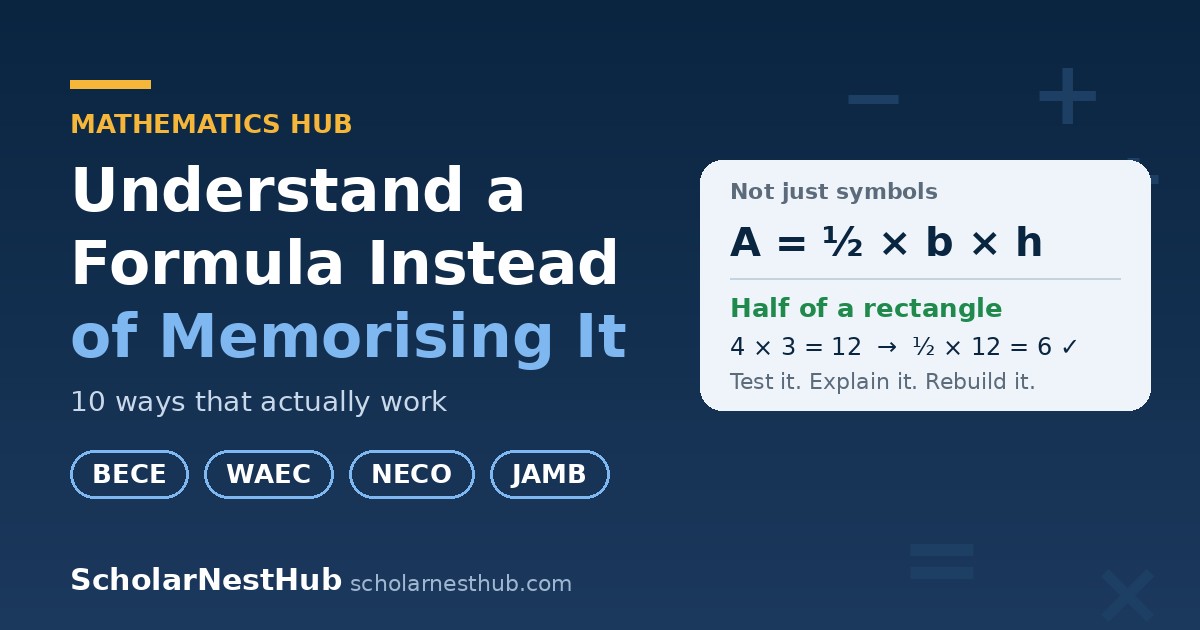
Before you trust a formula, try it where you already know the answer. A triangle with base 4 and height 3 should have half the area of a 4 by 3 rectangle. The rectangle has area 12, so the triangle should be 6, and ½ × 4 × 3 = 6 ✓. A circle of radius 1 fits inside a 2 by 2 square of area 4, so its area must be less than 4, and πr² = π ≈ 3.14 ✓. These quick tests catch half-remembered formulas, such as forgetting the ½.
6. Check the units
Units are a free error-detector. Lengths are in cm, areas are in cm² and volumes are in cm³. If your area formula gives cm, or your volume formula gives cm², something is wrong. A quick unit check can reveal that you have left out a power or mixed two different quantities.
Part 3: Know When and How to Use It
7. Learn the conditions
Many formulas only work in certain situations. Dawkins gives a clear example: to use the quadratic formula, the equation must first be in standard form, or you will often get the wrong answer. Consider x² + 5x = 14. You must rewrite it as x² + 5x − 14 = 0 before reading off a = 1, b = 5 and c = −14.
x = (−5 ± √(25 + 56)) ÷ 2 = (−5 ± 9) ÷ 2 → x = 2 or x = −7. Check: 2² + 5(2) = 14 ✓.
The same idea applies to Pythagoras’ theorem, which belongs to right-angled triangles only. Ask of every formula: when does this work, and when does it not?
8. Group related formulas into families
Formulas become easier to hold when you see how they connect. The volume of a cuboid is base area × height. So is the volume of a cylinder, where the base is a circle: V = πr²h. One idea gives you two formulas.
Cylinder with r = 7 cm and h = 10 cm (use π = 22/7): V = (22/7) × 7² × 10 = 22 × 7 × 10 = 1,540 cm³.
Do the same with area: a rectangle’s area leads to the triangle’s (half), and a triangle leads to the trapezium and the parallelogram. When you remember the family, you remember the members.
9. Match the formula’s parts to the problem’s parts
A formula is a template, and your job is to slot the right numbers into the right places. Dawkins points out that a general formula can be worthless if you cannot identify the pieces of the problem that correspond to its parts. To practise, alternate between a worked example and a similar problem you solve yourself. The IES guide found this alternating approach helps students learn more than simply working through a long list of problems. When you finish, ask why that formula was the right choice and what features of the question pointed to it.
Part 4: Lock It In
10. Explain it, then test yourself
Explain each formula aloud as if teaching a friend: what it means, where it comes from and when to use it. The IES panel rates this kind of “why” and “what if” questioning as strong evidence for deeper understanding, and it recommends thinking aloud as you study. Then close your notes and write the formula from memory, with a quick example. Try again a day later. If you stumble, return to the steps above for that formula only.
You can then practise recall with exam-style questions in our Math Hub.
What About Formulas You Simply Must Memorise?
Some memorising is unavoidable, and that is fine. Dawkins himself suggests index cards for important formulas you can review in spare minutes. The trick is to memorise after you understand. Put the formula on the front of the card, and on the back write the meaning of each symbol, a condition and a one-line example. Then your memory has something solid to hold on to.
Key Takeaways
• A formula you only memorised can fail when the question changes; one you understand can be rebuilt.
• Put each formula into plain words and list every symbol with its unit.
• Derive key formulas at least once and look at them as tables, graphs and stories.
• Test formulas with simple numbers and check the units of your answer.
• Learn the conditions under which a formula works, and group related formulas into families.
• Explain the formula aloud, then test yourself closed-book and repeat a day later.
Frequently Asked Questions About Understanding Formulas
Why is it better to understand a formula than memorise it?
Understanding lets you rebuild the formula if you forget it, spot mistakes and adapt it to new question styles. Memorised symbols alone can become useless when the wording of a question changes.
Do I still need to memorise some formulas?
Yes. A fair amount of memorising is normal in maths, but it works best after you understand what each formula means and when it applies.
How can I understand a formula quickly?
Say it in plain words, list what each symbol means, and test it with a simple number you can check in your head. These three steps take only a few minutes.
Should I try to derive every formula?
Not every one. Derive the key formulas in each topic once, especially those you keep forgetting, because building one yourself makes it much easier to remember.
How do I know when to use a particular formula?
Learn its conditions, then look at the features of the question that match. For example, the quadratic formula needs the equation in standard form first.
How do units help me check a formula?
Areas should come out in square units and volumes in cubic units. A mismatch signals that a part of the formula or your working is wrong.
What is the best way to practise formulas for WAEC or JAMB?
Alternate worked examples with similar problems, then test yourself without notes. Our guide on how to solve WAEC Mathematics theory questions fast shows how to present your working clearly.
Can formula cards help?
They can, if each card carries more than the formula. Add the meaning of each symbol, a condition and a short example on the back.
How can I explain a formula to myself?
Talk it through aloud: what it says, why it works, when it applies and what happens if a value changes. If you get stuck, you have found a gap to fix.
Does this approach work for Further Mathematics?
Yes, and it matters even more there because formulas are longer. See our article on overcoming the biggest difficulties in Further Mathematics.
Conclusion
Formulas are not magic spells to be recited; they are compact ideas you can understand, test and rebuild. Pick one formula you currently only memorise, apply the ten ways above, and notice how much easier it feels. Then keep going with exam-style practice in the ScholarNestHub Math Hub.
Need help on your own project?
Browse ready-made materials or request a custom topic from a verified academic writer.