
12 Ways to Stop Making Careless Mistakes in Calculations
Introduction
You studied. You understood the topic. Then your script came back, and the marks you lost had nothing to do with not knowing the method: a dropped negative sign, a number copied wrongly, a bracket ignored. If that is your story, you are in good company. Careless mistakes in calculations frustrate students at every level, and the good news is that most of them are fixable.
The key is to stop treating them as bad luck. Careless errors follow patterns, and patterns can be spotted and broken with simple habits. In this guide you will learn 12 practical ways to stop careless mistakes in calculations, with short worked examples that suit BECE, WAEC, NECO and JAMB-style questions.
These habits also work hand in hand with clear written answers. If you want to write better theory solutions too, read our guide on how to solve WAEC Mathematics theory questions fast. Let’s begin with the quickest way to improve: finding out which mistakes you actually make.
Part 1: Know Your Mistakes Before You Fix Them
1. Keep an error log
You cannot fix a habit you have not named. After every test or homework, record each lost mark in a small table with three columns: the error, why it happened, and how you will avoid it next time. Rutgers Learning Centers offers a template built on exactly this idea, and its example is the very problem many students face: “simple” arithmetic slips in multi-step questions (Rutgers Learning Centers).
Error
Why it happened
How I will avoid it
Wrote −6x as +6x
Rushed the sign
Circle every sign before moving on
Copied 1,296 as 1,926
Did not recheck the line
Read the new line aloud against the old one
Typed 8 + 4 ÷ 2 + 1
Forgot calculator brackets
Use brackets for every top and bottom line
After two or three weeks you will see the same two or three entries repeating. Those are your real targets.
2. Read the question twice and underline what is asked
Misreading is a classic careless error. The Iowa State University Academic Success Center guide lists misread directions first among test errors and gives a simple case: a student solves for x when the question actually wanted a product (Iowa State ASC).
Question: If 3x = 12, find 6x. A careless answer is x = 4. The question asks for 6x, so the answer is 6 × 4 = 24.
Underline the final request, such as “find 6x”, “correct to 2 decimal places” or “leave your answer in terms of π”, and glance at it again before you write your last line.
Part 2: Write Clearly So Mistakes Cannot Hide
3. Use neat, spaced-out working
Cramped, slanted or tiny handwriting turns a 3 into an 8 and a 1 into a 7. Use one line per step, keep the equals signs lined up, and leave space between questions. Neat working is also much easier to check, which matters later in this guide.
4. Show every step instead of doing it in your head
Mental shortcuts feel faster, but they remove the trail you need when something goes wrong. Write the small steps, especially with negatives, fractions and brackets. A few extra seconds on the page often saves a whole mark.
5. Copy numbers carefully
Transcription errors are sneaky because the method is perfect and the numbers are not. The Iowa State guide lists miscopying an answer from scratch paper into the answer booklet as one of the test-taking errors students make. After copying any number from the question or your rough work, compare the two versions digit by digit. Pay extra attention to pairs such as 1,296 and 1,926.
Part 3: Guard the Usual Danger Zones
6. Respect the order of operations (BODMAS)
Brackets first, then orders (powers and roots), then division and multiplication, then addition and subtraction. The Iowa State guide uses the same idea under the name PEMDAS and shows how forgetting it turns a correct −2 into 30.
Evaluate: 2(1 + 3) − 2 × 5. Brackets: 2(4) − 2 × 5 → 8 − 10 = −2.
Wrong answers often appear when you simply work from left to right. Say the order to yourself before you start a long expression.
7. Treat negative signs as part of the number
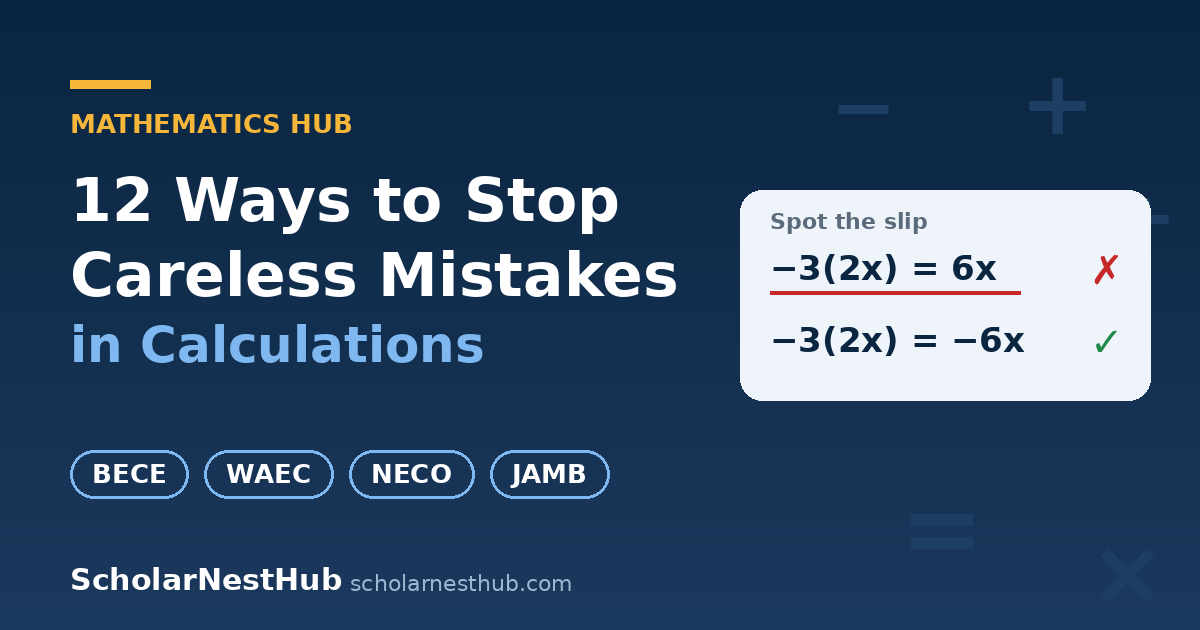
Signs are one of the biggest sources of lost marks. The Iowa State guide’s careless-error example is treating (−3)(2x) as 6x instead of −6x. Put brackets around negative numbers and circle each sign as you move it across an equals sign or expand a bracket.
−(x − 4) = −x + 4, because the minus outside changes both signs inside.
8. Use your calculator with brackets and a second look
A calculator does exactly what you type, not what you meant. Clear it before each question, put brackets around numerators and denominators, and read the screen back against your plan.
Intended: (8 + 4) ÷ (2 + 1) = 12 ÷ 3 = 4. Typed without brackets: 8 + 4 ÷ 2 + 1 = 8 + 2 + 1 = 11, which is wrong.
If a result looks odd, repeat the key press sequence rather than trusting the first answer.
Part 4: Check, Pace Yourself and Keep Improving
9. Estimate first
Before you calculate, round the numbers and get a rough answer. If your exact answer is far from your estimate, a digit or decimal point has probably slipped.
49 × 21 is about 50 × 20 = 1,000. The exact answer is 1,029. An answer like 10,290 or 102.9 would be instantly suspicious.
10. Check by substituting back or reversing the steps
Do not simply reread your working. Test the answer. Put it back into the original equation, or reverse the operation.
Solve: 4x − 7 = 25 → 4x = 32 → x = 8. Check: 4(8) − 7 = 25 ✓.
A careless slip such as 4x = 25 − 7 = 18 gives x = 4.5. Checking: 4(4.5) − 7 = 11, not 25, so the error is caught at once.
11. Manage your time and protect correct answers
Rushing causes many careless errors. The Iowa State guide advises keeping track of the time left, starting with the problems you find easier, and not changing an answer unless you are completely sure. Plan a few minutes at the end to run through your sums, checking signs, copied numbers and the final request.
12. Learn from old tests and past questions
The same guide recommends looking back at old exams to avoid repeating past mistakes. Redo a corrected paper after a week, mark it, and add new patterns to your error log. You can also practise under exam-style conditions with the mock exams in our Math Hub.
Key Takeaways
• Careless errors have patterns, so record them in an error log and fix the repeating ones first.
• Read the question twice and underline exactly what is being asked.
• Write neatly, show your steps and copy numbers digit by digit.
• Guard the danger zones: order of operations, negative signs and calculator brackets.
• Estimate before calculating, then check by substitution or reversing the steps.
• Manage your time, change answers only when you are sure, and learn from old tests.
Frequently Asked Questions About Careless Mistakes in Calculations
What are careless mistakes in calculations?
They are slips you can fix yourself once you notice them: a wrong sign, a miscopied digit, a skipped bracket or a misread instruction. They differ from concept errors, where you do not yet understand the method.
Why do I make careless mistakes even when I understand the topic?
Understanding the method does not guarantee accuracy. Rushing, cramped working and weak checking habits cause errors even when your concepts are strong.
What is the fastest way to reduce careless mistakes?
Start an error log. Spotting your two or three most repeated mistakes lets you aim your effort where it counts.
How do I stop sign errors in algebra?
Put brackets around negative numbers, circle signs as you work, and test your answer by substituting it back into the original equation.
Should I do steps in my head to save time?
It is safer to write the small steps, especially with negatives, fractions and brackets. The seconds you save are rarely worth the marks you may lose.
How do I check my answers if I am short on time?
Use quick checks: compare the answer with an estimate, confirm it answers the actual question, and recheck signs and copied numbers.
Does neat handwriting really matter in maths?
Yes. Clear digits and tidy lines reduce misreading, and they make your own checking faster and more reliable.
Should I change my answer during review?
Only if you are completely sure the first answer is wrong. Changing correct answers to incorrect ones is a known test-taking error.
How can I practise to avoid careless mistakes?
Do short, regular sessions, correct every mistake, and revisit old papers. You can include JAMB Mathematics questions that tend to repeat in your routine.
How do I avoid calculator mistakes?
Clear the calculator first, use brackets for fractions and long expressions, and repeat the key presses when a result looks unexpected.
Conclusion
Careless mistakes are not a sign that you are bad at maths. They are signs that your habits need tuning. Choose three ways from this list, apply them to your next homework, and add more as they become automatic. Ready to practise? Visit the ScholarNestHub Math Hub and put these habits to work on exam-style questions today.
Need help on your own project?
Browse ready-made materials or request a custom topic from a verified academic writer.