
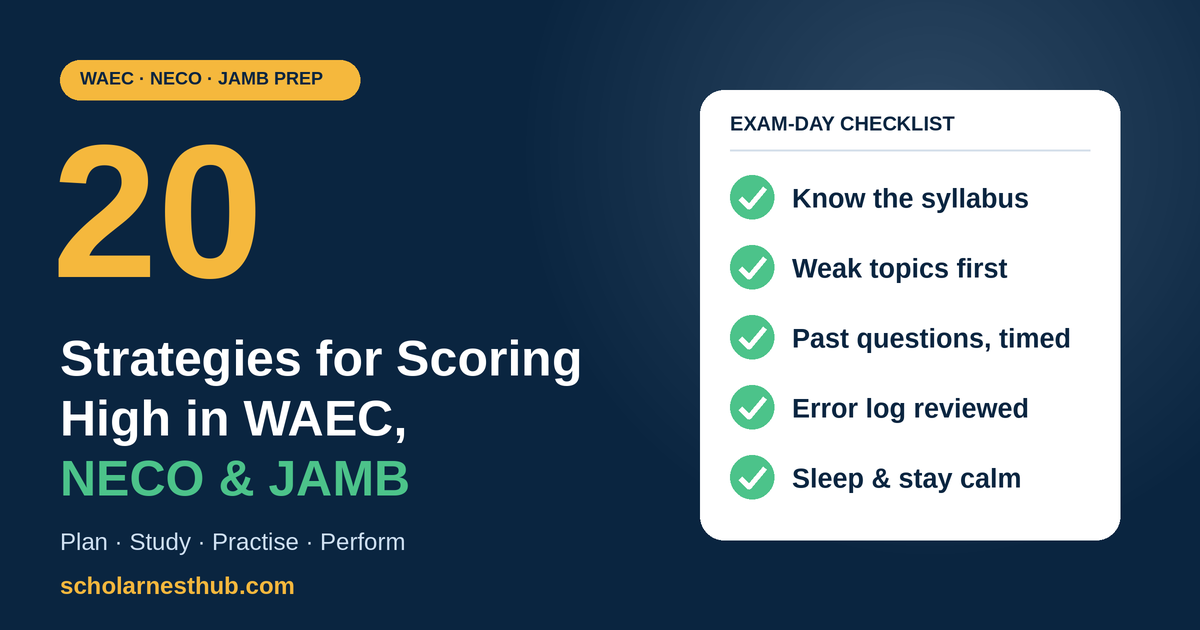
20 Strategies for Scoring High in WAEC, NECO and JAMB
Introduction
Every year, thousands of Nigerian students sit WAEC, NECO and JAMB within a few months of each other, and many wonder how anyone manages to score high in all three. The answer is rarely genius or luck. It is usually a clear plan, smart revision habits and calm, careful exam technique. Whether you are aiming for a strong WASSCE result, a solid SSCE grade or a competitive UTME score, the same foundations apply.
This guide gives you 20 practical strategies to score high in WAEC, NECO and JAMB, whether you are in SS2, SS3 or retaking an exam. Each strategy is simple enough to start today, and they are grouped into four stages: planning, studying, practising and exam-day performance.
You do not need to do everything at once. Pick three or four strategies, apply them for a week, then add more. If Mathematics is your biggest worry, pair this article with our 90-day plan for WAEC, NECO and JAMB Mathematics, which shows how to structure the subject week by week.
Understand the Three Exams Before You Start
WAEC's WASSCE and NECO's SSCE are senior secondary school certificate examinations, while JAMB's UTME is the entrance examination used for admission to tertiary institutions. Their content overlaps, but their formats and purposes differ, so your preparation should too.
NECO's own SSCE Internal user guide explains that the exam is taken by final-year secondary school candidates, and that Mathematics, English and Civic Education are selected automatically, alongside other subjects the candidate chooses. The guide is written mainly for schools, so confirm your own subject details with your school.
Stage 1: Plan Your Preparation (Strategies 1 to 5)
1. Know the format of each exam
Find out how many papers each subject has and what types of questions appear. Preparing for essay and theory papers is different from preparing for the computer-based, multiple-choice style of UTME.
2. Get the official syllabus for every subject
The syllabus tells you exactly what can be examined. Download or copy it from the relevant exam board and tick off each topic as you master it.
3. Build a timetable backwards from exam day
Start from your exam dates and work backwards. Divide the weeks left among your subjects and leave the final two weeks for revision and mixed practice only.
4. Put your weakest topics first
List every topic as strong, average or weak. Give the weak ones the earliest and most alert study slots, because those topics hold the most marks you can still gain.
5. Secure your core subjects early
Mathematics and English matter across almost every course and certificate, so give them steady attention every week instead of leaving them until the last month.
Stage 2: Study Smart, Not Just Long (Strategies 6 to 10)
6. Study in short, focused blocks
Work for 30 to 45 minutes, then rest for five to ten. Phones away, one topic at a time. Short, distraction-free sessions beat three tired hours in front of an open textbook.
7. Use active recall
Close your notes and write down what you remember, or solve a question without looking at the solution. Reading feels easy but proves little, while recall shows what you truly know.
8. Revise in spaced cycles
Return to each topic after a day, a week and then a few weeks. Revisiting material over time helps it stay with you much better than a single cramming session.
9. Learn from Chief Examiners' comments
WAEC's e-learning portal provides past papers with Chief Examiner comments on candidate performance in its Mathematics section, covering strengths and weaknesses. Reading those comments shows you which mistakes cost candidates marks, so you can avoid them. Check whether similar pages exist for your other subjects.
10. Make short summary sheets
Condense each topic into one page of formulas, definitions, diagrams and common traps. These sheets become your fastest revision tool in the last few weeks.
Stage 3: Practise Like It Is the Real Exam (Strategies 11 to 15)
11. Do past questions by topic, then by full paper
Begin with topic-based questions to build skill, then switch to complete papers to build stamina and exam rhythm. Repeating questions from several years also helps you see how topics are tested.
12. Time yourself
Set a timer that matches the real paper. Practising under time pressure trains you to decide quickly when to continue and when to move on.
13. Practise on a computer for JAMB
UTME is computer-based, so get comfortable reading questions on screen and selecting answers quickly. You can practise exam-style questions with feedback in the Scholarnesthub Math Hub.
14. Keep an error log
Write down every question you miss, the reason and the correct method. Review the log weekly. Most students repeat the same few mistakes, and the log makes them visible.
15. Teach what you have learned
Explain a topic to a friend or sibling, or study with a small, serious group. If you cannot explain a step simply, you probably need to revise it again.
Stage 4: Perform on Exam Day (Strategies 16 to 20)
16. Read every instruction twice
Many marks are lost to answering the wrong thing: too few questions, the wrong unit, or the wrong number of decimal places. Underline key words before you begin.
17. Show your working
In theory papers, clear steps can earn method marks even if the final answer is wrong. Present your work neatly so the examiner can follow your reasoning.
18. Manage your time by section
Divide the time across questions according to their marks. Begin with the questions you are sure about, mark the hard ones, and return to them later.
19. Protect your sleep, food and calm
Eat properly, sleep well in the last few nights and arrive early. If anxiety rises, breathe slowly and focus on the next question only. A rested mind recalls far more than a worried one.
20. Rely on honest preparation
Follow all exam rules and avoid anything that could be treated as malpractice, which can put your results at risk. The surest route to a high score is knowledge you have built yourself.
Key Takeaways
· Know the format and syllabus of each exam before you start revising.
· Plan backwards from your exam dates and tackle weak topics first.
· Use active recall, spaced revision and short, focused study blocks.
· Practise past questions by topic first and then in full, timed papers.
· Study Chief Examiners' comments to learn which mistakes to avoid.
· Keep an error log and review it every week.
· On exam day, read instructions carefully, show working and manage your time.
· Look after your sleep and calm, and rely on honest preparation.
Frequently Asked Questions
Can I prepare for WAEC, NECO and JAMB at the same time?
Yes. The syllabus content overlaps, so most revision serves all three. Add extra practice for the format of each exam, especially computer-based questions for JAMB.
What is the difference between WAEC, NECO and JAMB?
WAEC and NECO conduct senior secondary school certificate examinations, while JAMB conducts the UTME, the entrance exam for admission to tertiary institutions.
When should I start preparing?
As early as possible. Starting several months before the exams gives you time to repair weak topics and to practise past questions properly.
How many hours should I study each day?
Quality matters more than hours. Two to four focused hours on school days, with breaks, is a realistic target for many students, and you can adjust it to your own schedule.
Are past questions enough to score high?
They are essential, but not enough alone. Use them together with the syllabus, your notes and an error log so you understand why answers are right.
Which subjects are compulsory in NECO SSCE Internal?
According to NECO's SSCE Internal user guide, Mathematics, English and Civic Education are selected automatically. Confirm your full subject list with your school.
Where can I find WAEC past questions?
WAEC's e-learning portal hosts past papers with Chief Examiner comments for Mathematics, and its navigation lists other subjects too.
How do I handle exam anxiety?
Prepare thoroughly, practise under timed conditions and sleep well. During the exam, breathe slowly and focus on one question at a time. If anxiety is severe, talk to a teacher or counsellor.
How can I practise JAMB-style computer-based questions?
Use timed, on-screen practice with feedback. The Scholarnesthub Math Hub offers JAMB, WAEC and Post-UTME style mock practice.
Conclusion
Scoring high in WAEC, NECO and JAMB is built from small, repeatable habits: a plan, smart revision, regular timed practice and calm exam technique. Choose three strategies from this list and start today.
Ready to practise? Visit the Scholarnesthub Math Hub and take your first timed practice session this week.
Need help on your own project?
Browse ready-made materials or request a custom topic from a verified academic writer.