
AI vs Traditional Research: What Nigerian Students Need to Know
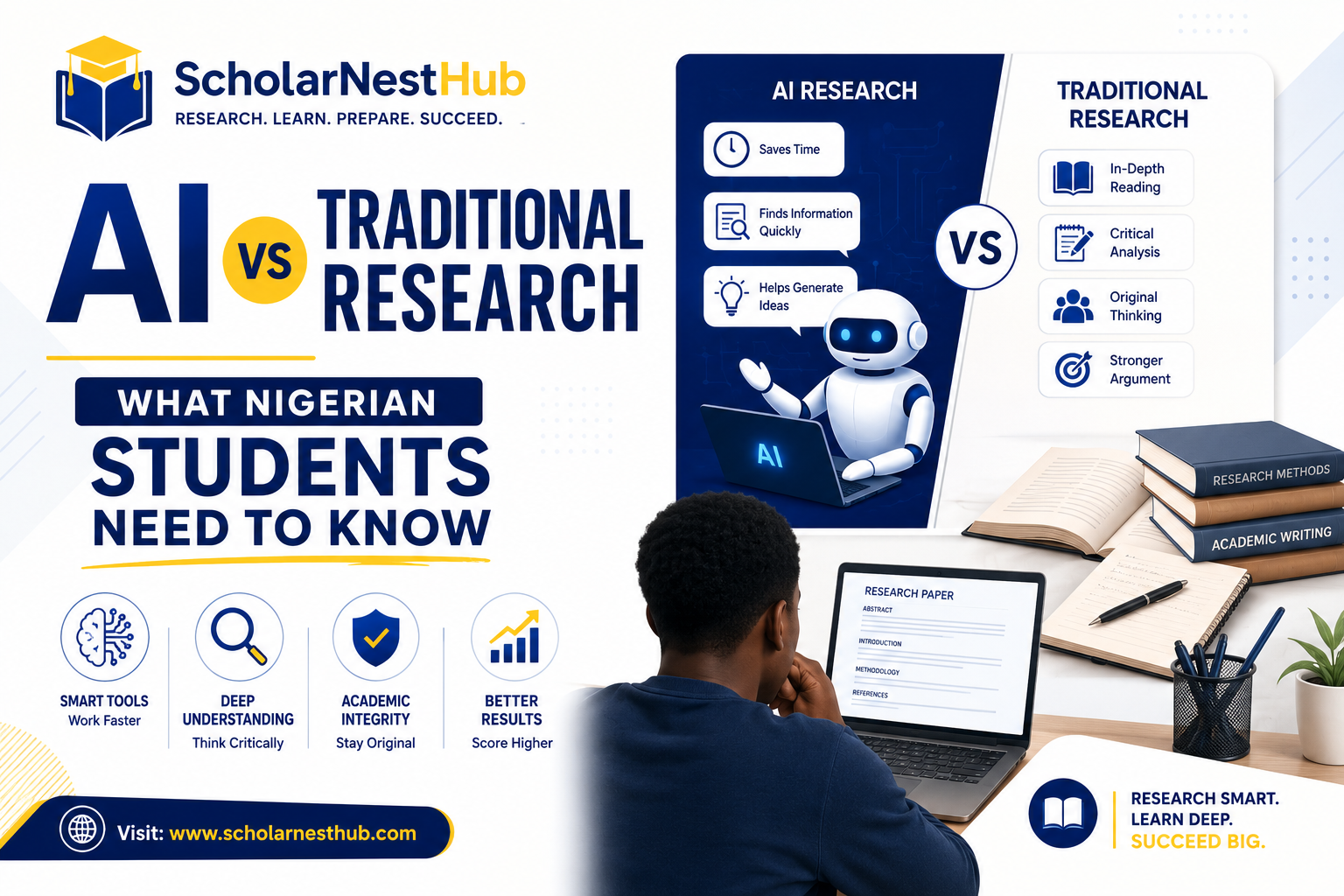
Every final-year student in Nigeria today is writing a project in the shadow of two very different research traditions. The older one built on library visits, printed journals, supervisor meetings, and hand-tallied questionnaires still shapes how most departments grade a project. The newer one, built on AI chat tools, automated summarisers, and instant literature searches, has become part of daily student life whether departments have caught up to it or not. Understanding what each tradition actually offers, and where they genuinely overlap, matters more than picking a side.
This guide breaks down what traditional research still does better, what AI tools now do faster, and how to combine both approaches without falling foul of your department's rules on originality. If you are still deciding on a topic or structure for your own project, browsing a sample research library of structured project topics is a useful way to see how a well-organised paper looks before you start.
By the end of this article, you should be able to explain, in your own defence session if needed, exactly where AI assisted your process and where the thinking, analysis, and judgement remained yours.
What Traditional Research Actually Involves
Traditional research is less a single method than a chain of manual, verifiable steps. A student picks a topic, searches physical or digital library catalogues, reads full papers rather than summaries, drafts a literature review by hand, designs a questionnaire, administers it to a real sample, and analyses the responses using statistical software. Every step leaves a paper trail a supervisor can retrace.
That traceability is exactly why examiners still trust it. A student who can explain why they chose a Likert scale over an open-ended question, or why their sample size follows a particular formula, demonstrates understanding rather than output. Traditional research is slow, but the slowness is often where the learning actually happens.
What AI Tools Can and Cannot Do in Research
Where AI Genuinely Helps
Used well, AI tools speed up the parts of research that are mechanical rather than analytical. They can help you scan dozens of abstracts quickly to decide which papers are worth reading in full, suggest search terms you had not considered, tidy up grammar and sentence flow, and format references once you supply the correct source details.
For a Nigerian student juggling a project alongside coursework, exams, and often a part-time job, that time saved on mechanical tasks is real and legitimate, as long as the saved time goes into deeper reading and analysis rather than skipping those steps entirely.
Where AI Falls Short
AI tools do not collect your primary data, do not know your specific study population, and can generate confident-sounding claims that are not actually supported by real literature. A chatbot asked to summarise a study it has never actually read will sometimes produce a plausible but inaccurate summary. It can also flatten nuance, presenting a contested finding as settled fact when the underlying research is far less certain.
This is precisely the gap that traditional methods still fill. Fieldwork, direct interviews, and hands-on statistical analysis remain the only reliable way to generate new, context-specific evidence about Nigerian markets, institutions, and communities that no AI model has been trained on in sufficient depth.
The Real Difference Between AI Assistance and AI Substitution
The distinction that matters to your department is not whether you touched an AI tool at all. Almost every student now does, in one form or another. What matters is whether AI assisted your thinking or replaced it.
● Assistance looks like: using AI to summarise a dense paper before you decide whether to read it fully, asking it to check your grammar, or having it suggest alternative phrasing for a paragraph you already wrote.
● Substitution looks like: asking AI to generate your literature review from scratch, inventing data because collecting real responses feels slower, or copying an AI-written discussion section without checking it against your own results.
Supervisors are increasingly able to spot the second category, not through detection software alone, but because substituted sections tend to read generically and rarely connect precisely to the specific data a student actually collected.
What Nigerian Universities and Global Bodies Say About AI Use
UNESCO's Guidance for Generative AI in Education
At the international level, UNESCO's Guidance for Generative AI in Education and Research takes a human-centred position on how these tools should be used in academic settings. The guidance stresses that generative AI should support human agency rather than replace it, and it calls on institutions to set clear rules on data privacy and appropriate use rather than leaving students to guess where the line sits.
The practical takeaway for a Nigerian student is straightforward. International guidance treats AI as a tool to be governed and understood, not banned outright and not used without limits either.
How Nigerian Institutions Are Responding
Nigerian universities are beginning to formalise their own positions. The National Open University of Nigeria's Policy on the Adoption of Artificial Intelligence, approved by the university's Senate, explicitly permits AI-powered tools in project and thesis writing and research, but only on the condition that their use does not violate the institution's existing policy on plagiarism.
That single condition is worth reading twice. It means AI use itself is not the violation. Presenting AI-generated or AI-paraphrased work as entirely your own, without disclosing how it was used, is what crosses into misconduct. If your own department has not yet published a written AI policy, it is worth asking your supervisor directly rather than assuming either extreme is safe.
A Practical Framework for Blending AI and Traditional Methods
Rather than treating this as a choice between two competing systems, most successful Nigerian student projects now blend them deliberately, stage by stage.
● Topic selection: use AI to explore possible angles quickly, then confirm the gap is real by reading recent primary studies yourself.
● Literature review: let AI help you locate and summarise candidate papers, but read the sources that matter most in full before citing them.
● Data collection: keep this stage entirely traditional. Administer your questionnaire or interviews to a real sample; no AI tool can ethically substitute for this.
● Data analysis: use statistical software for the actual computation, and use AI only to help you understand or explain a statistical concept you are unsure about.
● Writing and editing: draft your own arguments first, then use AI sparingly for grammar, structure suggestions, and clarity, always reviewing every change it proposes.
If you want a deeper sense of what separates a project that merely satisfies formatting requirements from one that genuinely adds something new, this guide on the essence of research and how to genuinely contribute to your field walks through that distinction in detail.
Common Mistakes Nigerian Students Make With AI in Research
A few patterns show up again and again in projects that run into trouble. Students sometimes accept an AI-generated citation without confirming the source actually exists, since AI tools can occasionally produce references that look correct but were never published. Others paste an AI summary of a paper into their literature review without reading the original, missing important caveats the summary left out. A smaller but more serious group asks AI to invent survey responses to save time, which is a form of data fabrication regardless of how the request was phrased.
Each of these mistakes is avoidable with one habit: treat every AI output as a first draft that must be checked against a real, verifiable source before it goes anywhere near your final document.
Staying on the Right Side of Academic Integrity
The safest approach is disclosure and verification. Keep a simple personal log of where you used AI tools and for what purpose, so you can explain your process confidently if a supervisor asks. Verify every fact, statistic, and citation an AI tool gives you against the original source before it appears in your work. And treat data collection and final analytical judgement as tasks that stay firmly in your own hands, since these are the parts of a project your degree is actually certifying that you can do.
Key Takeaways
● Traditional research still owns data collection, fieldwork, and the kind of traceable reasoning examiners trust most.
● AI tools are strongest at mechanical tasks: summarising, searching, and tidying language, not generating original findings.
● The real dividing line is assistance versus substitution, not whether AI was used at all.
● UNESCO's guidance frames AI as a tool to govern responsibly, not one to ban or use without limits.
● NOUN's Senate-approved policy permits AI in project and thesis writing as long as it does not breach existing plagiarism rules.
● A stage-by-stage blend, AI for the mechanical work and traditional methods for data and judgement, produces the strongest, most defensible projects.
Frequently Asked Questions
Is it allowed to use AI tools like ChatGPT for my final-year project in Nigeria?
Most Nigerian institutions do not ban AI outright. Policies such as NOUN's Senate-approved AI policy permit AI-powered tools in project and thesis writing, provided their use does not violate the institution's plagiarism rules. Check your own department's specific guidance, since individual faculties may set stricter conditions.
Can my supervisor tell if I used AI to write my project?
Often, yes, though not always through detection software. Sections generated or lightly edited from AI output tend to read generically and connect loosely to a student's actual data or argument, which experienced supervisors notice quickly.
Is AI research faster than traditional research?
AI speeds up mechanical tasks like summarising papers and formatting references. It cannot speed up data collection, fieldwork, or the reasoning needed to interpret your specific results, which still take as long as they always have.
Can AI collect and analyse my questionnaire data for me?
AI tools can help explain statistical concepts or troubleshoot a formula, but the actual collection of responses from a real sample, and the core analytical judgement, should remain your own work using proper statistical software.
What is the safest way to use AI without risking plagiarism?
Keep a personal record of where and how you used AI, verify every fact and citation it produces against the real source, and make sure your final arguments and data interpretation are written in your own words based on your own understanding.
Do AI tools ever generate fake citations or sources?
Yes, this happens. AI tools can produce references that look plausible but do not correspond to any real, published work. Always confirm a citation exists in a genuine database or journal before including it in your project.
Does using AI for grammar checking count as academic misconduct?
Generally no. Using AI to catch grammar issues or suggest clearer phrasing is closer to using a spell checker than to substituting your own thinking, as long as the underlying ideas and arguments remain yours.
Should undergraduate and postgraduate students treat AI use differently?
The core principle is the same for both, but postgraduate work is usually held to a higher bar of originality and methodological rigour, so postgraduate students should be even more cautious about relying on AI for anything beyond mechanical tasks.
What does UNESCO recommend about AI in student research?
UNESCO's Guidance for Generative AI in Education and Research recommends a human-centred approach, where AI supports human agency and institutions set clear standards for its use rather than leaving students without guidance.
Where can I see how a well-structured research project looks before I start mine?
Browsing a sample research library of structured project topics is a practical way to study real examples of methodology, structure, and citation style across different departments before you begin writing.
Conclusion
AI and traditional research are not rivals fighting for the same job. One handles the mechanical load, the other handles data, judgement, and original thinking, and a strong Nigerian student project needs both working together rather than one replacing the other. Get clear on where the line sits in your own department, verify everything an AI tool hands you, and keep the parts of the process that your degree actually certifies firmly in your own hands.
Ready to see this balance in action? Explore a sample research library of structured project topics on ScholarNestHub to study how well-executed projects combine solid methodology with clear, original analysis.
Need help on your own project?
Browse ready-made materials or request a custom topic from a verified academic writer.