
How to Answer Any Exam Question: A Four-Step Method
INTRODUCTION
You revised hard, you walked into the hall prepared, and yet you still lost marks. Often the problem is not what you know but how you answer. Students write everything they remember on a topic when the question asked for something narrower, or they describe when they were told to explain. Learning how to answer exam questions is a skill you can practise, and it works for WAEC, NECO and JAMB theory papers as well as university tests.
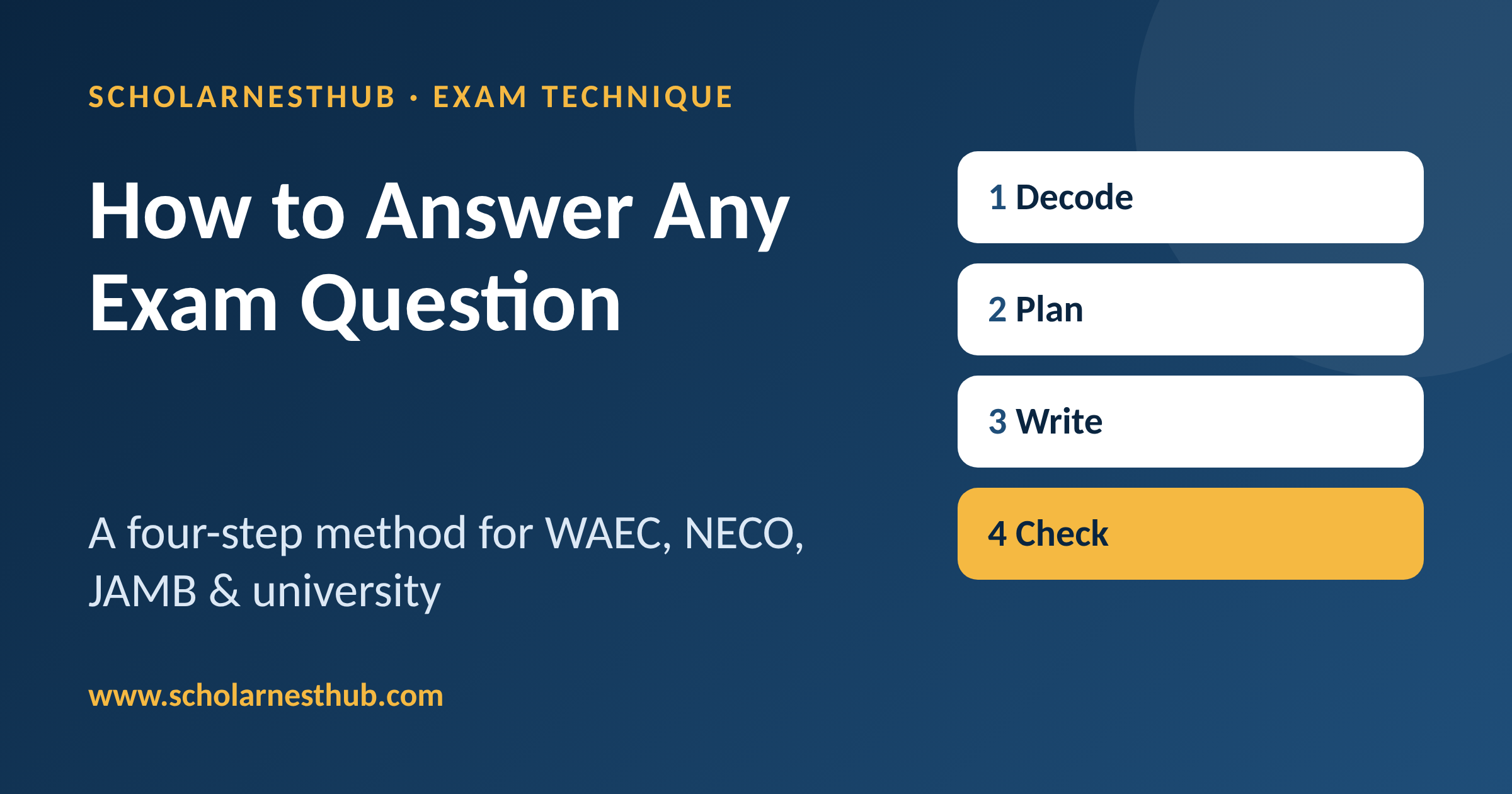
This guide gives you a simple four-step method you can apply to almost any question: Decode, Plan, Write, Check. Each step comes with examples from subjects such as Biology, Government, Economics and Mathematics. If you are still building your revision routine, browse the study guides on the Scholarnesthub blog first, then come back and use this method on every past question you practise.
The method takes under two minutes to start on each question. That small investment protects your marks.
How to Answer Any Exam Question: A Four-Step Method
Before the Four Steps: Read the Whole Paper
Take the first few minutes to look through the paper. The University of Sheffield advises reading the instructions at least twice, reading the whole paper once, noting how many questions you must answer, and allocating time to each question in proportion to its marks. In practice, write the time you will spend on each question beside it. If a question is worth twice the marks, it earns about twice the time.
Also choose carefully when you have options. Sheffield warns against picking a question just because it looks easy at first glance. Read each option fully before deciding.
Step 1: Decode the Question
Most lost marks begin here. Before you write a single line, break the question into its parts.
Find the topic, the focus and the command word
The University of Melbourne suggests identifying three things in every question: the topic, the focus or scope, and the direction word. Underline them. Take this example: "Explain two causes of soil erosion in your area." The topic is soil erosion, the focus is two causes in your area, and the command word is explain.
Understand what the command word wants
Command words tell you what kind of answer earns marks. Sheffield's guidance gives definitions you can use, such as:
• Explain: address how or why something happens.
• Compare: look at similarities, though differences may be mentioned.
• Contrast: stress the differences.
• Discuss: examine an argument, giving reasons for and against.
• Evaluate: appraise advantages and limitations.
• Outline: give an organised, systematic description.
• Summarise: give the main points in condensed form.
Melbourne adds that words like describe, define and list ask you to present knowledge, while words like explain, compare and discuss ask you to apply ideas and usually need deeper thinking. Check which one your exam board uses most, and practise answering each type.
Respect the limits
Note numbers and limits: "two causes", "in Nigeria", "since 1999". Melbourne points out that content outside the focus, or extra items beyond what is asked, earns no marks. If the question asks for two, give two.
Step 2: Plan Your Answer in One or Two Minutes
A quick plan makes your answer clearer and keeps you on topic. Sheffield recommends spending time planning before writing, starting with a mind-dump of ideas, then keeping only the key points that match the marks on offer.
A simple planning routine
• Mind-dump: write every idea, term or formula that comes to mind in the margin or rough-work area.
• Select: circle the points that answer the question and cross out the rest.
• Order: number the points in the sequence you will use.
• Match marks: aim for roughly one clear point per mark when the marks are shown.
Melbourne also suggests noting your main point, key terms to define, supporting examples and whether you will use paragraphs, dot points or a diagram.
Example plan: a Government question
Suppose the question says: "Discuss the importance of separation of powers." Your plan could be: definition, the three arms of government, how each limits the others, one Nigerian example, and a short conclusion. In two minutes you have a structure that will keep you from rambling.
Example plan: a Mathematics question
For a word problem, list what is given, what is asked and which formula links them. Then write your steps in order. A clear plan helps you pick up method marks even if you make an arithmetic slip, though the exact marking rules depend on your examiner, so show your working neatly.
Step 3: Write a Clear, Focused Answer
Now you turn the plan into words. Keep your writing direct and organised.
Start by answering the question
Melbourne suggests opening by restating the key words of the question without copying the whole thing. For example: "Soil erosion in my area is caused mainly by heavy rainfall and bush burning." Then expand each cause in its own paragraph.
Use one idea per paragraph or point
Make a point, explain it, then give an example. This pattern is easy to follow and easy to mark. In essay-type answers, linking words such as "therefore", "however" and "as a result" show how your ideas connect, as Melbourne advises.
Use correct terms and neat layout
Use the technical words you learned in class, spell them correctly and write legibly. Melbourne notes that dot points and clearly labelled diagrams can be as effective as paragraphs where allowed, and that diagrams should be well labelled and accompanied by some explanation. Check your exam instructions to see what is permitted.
Answer objective questions with the same discipline
For multiple-choice papers such as JAMB, the same habit applies. Read the whole question, note any words like "not" or "except", predict the answer before reading the options, then choose. This is general advice rather than a rule from any single source.
Step 4: Check and Manage Your Time
Time and checking make the difference between a good answer and a finished one.
Watch the clock
Sheffield recommends keeping an eye on the clock and moving on if you overrun or get stuck. Do not let one hard question eat the time of three easier ones. Leave a gap, finish others, and come back.
If time is running out
Both universities offer rescue advice. Sheffield says to focus on the first sections of questions, which often carry easier marks, and to use bullet points if time is very short while still reaching a conclusion. Melbourne similarly suggests dot points or diagrams where permitted.
Proofread before you leave
Reserve the last few minutes to read your work. Look for missing units, unfinished sentences, wrong signs and questions you skipped. Sheffield says that time spent proofreading is well spent and that you should never leave the exam early.
Putting the Method into Practice
Use this method on every past question you do. Practise it under timed conditions, because Melbourne recommends doing so before the exam. Afterwards, mark yourself and ask three questions:
• Did I identify the command word correctly?
• Did I stay within the focus of the question?
• Did I run out of time, and where?
Over a few weeks your decoding and planning will become quick. For help organising your preparation, see our guides on the Scholarnesthub blog.
Common Mistakes to Avoid
• Writing everything you know. Answer only what is asked.
• Ignoring the command word. Describing when asked to evaluate loses marks.
• Skipping the plan. Rambling answers are harder to mark and to write.
• Spending too long on one question. Match your time to the marks.
• Leaving early. Use leftover time to check your work.
Key Takeaways
• Use the four steps: Decode, Plan, Write, Check.
• Read the whole paper first and give each question time in line with its marks.
• Underline the topic, the focus and the command word.
• Make a two-minute plan before you write.
• Open by answering, use one idea per paragraph, and use correct terms.
• Watch the clock, keep your answers within scope and proofread at the end.
Frequently Asked Questions
What is the best way to answer an exam question?
Decode what is asked, plan briefly, write a focused answer and check it. These four steps work for most subjects and question types.
What is a command word in an exam question?
It is the action verb that tells you how to answer, such as explain, compare, discuss or evaluate. Each one asks for a different type of response.
How long should I spend planning an answer?
A minute or two is usually enough for a theory question. Make it quick: a short list of ideas in order.
How do I avoid writing off-topic?
Underline the topic and focus in the question, and compare each point in your plan against them. Delete points that do not answer the question.
What should I do if I do not know the answer?
Write what you do know that is relevant, using key terms and a clear structure. Leave space, move on and return later if time allows.
How do I manage time in a long paper?
Allocate time in proportion to the marks and write the target time beside each question. Move on when the time is up.
Should I answer easy questions first?
It can build confidence, but choose carefully. Sheffield advises reading the options fully instead of picking a question because it looks easy at first glance.
Does the method work for Mathematics?
Yes. Write what is given and what is asked, choose a formula, show steps clearly and check the result. See more exam tips in the Scholarnesthub study guides.
Does it work for JAMB multiple-choice questions?
The habits of careful reading, noticing key words and checking apply, though the written steps are shorter. Practise with timed past questions.
How can I practise this method?
Use past questions, time yourself, apply the four steps and mark honestly. Note where you lose marks and fix that habit first.
Conclusion
Knowing the content is half the battle. Decoding the question, planning, writing with focus and checking your work turns knowledge into marks. Try the four-step method on your next practice paper, and explore the Scholarnesthub blog for more help with exam success.
Need help on your own project?
Browse ready-made materials or request a custom topic from a verified academic writer.