
How to Design an Effective Research Questionnaire: A Step-by-Step Guide
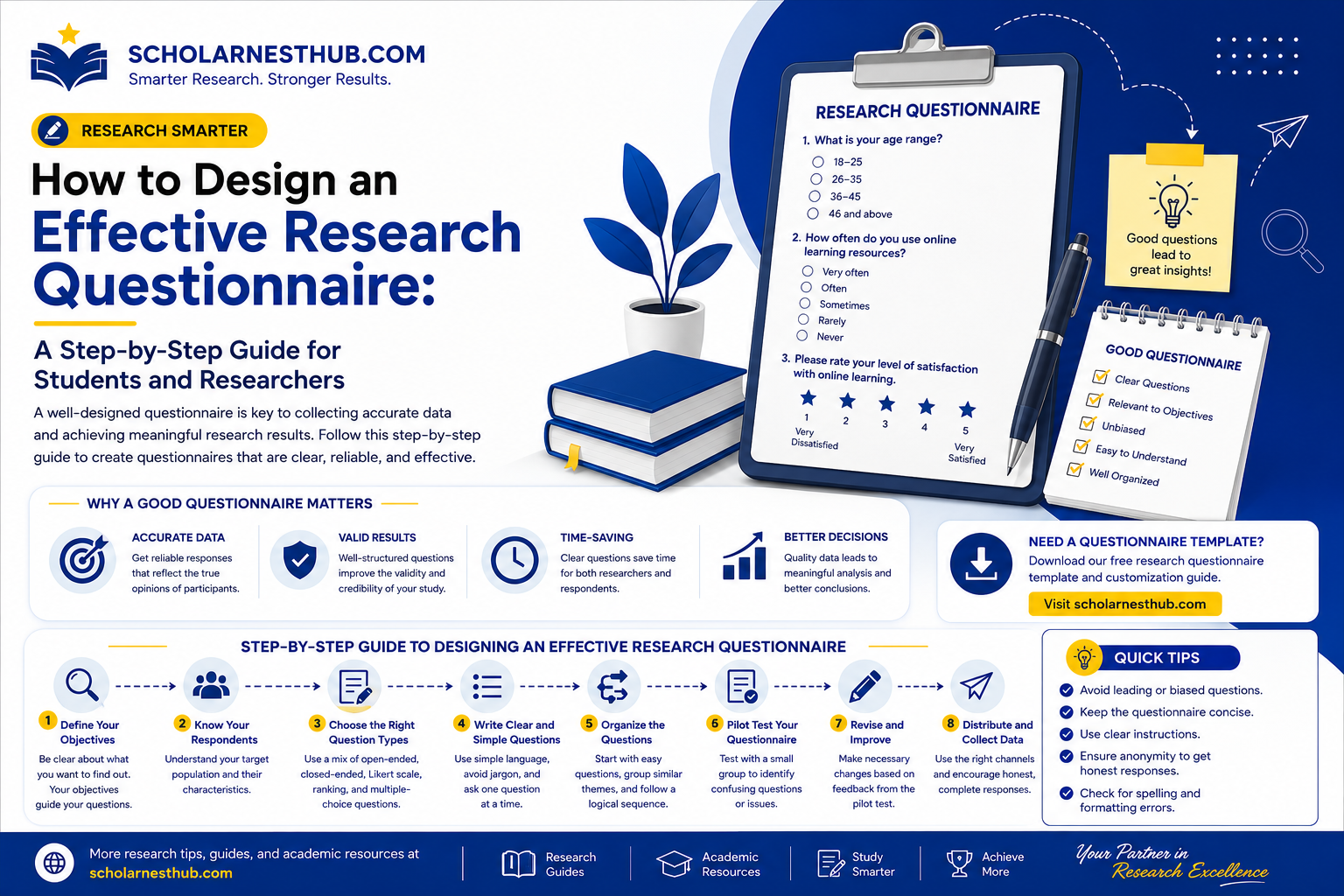
A weak questionnaire can quietly sink an otherwise solid research project. Vague questions produce vague data, biased wording produces skewed results, and a poorly piloted instrument means you won't discover the problems until you're already analysing responses — by which point it's too late to fix them. Whether you're an undergraduate collecting data for your final year project or a postgraduate student building a validated instrument for your thesis, the questionnaire is often the single most important tool in your entire methodology chapter.
This guide breaks the process down into clear, practical steps — from defining your objectives to piloting and refining your final instrument. If you haven't settled on a research topic yet, our Project Topics page has ideas across several disciplines to help you get started before you begin designing your data collection tools.
Step 1: Define Your Research Objectives Before You Write a Single Question
It's tempting to open a blank document and start typing questions, but that's how questionnaires end up bloated and unfocused. Start instead by writing out your research questions and hypotheses in full. Every item you eventually include should trace back to one of these — if a question doesn't help answer your research question, it doesn't belong in the instrument.
This step also determines what kind of data you need. Are you measuring attitudes and perceptions (which usually calls for scaled items), collecting factual or demographic information (which calls for closed or categorical questions), or exploring experiences in more depth (which might call for open-ended items)? Getting this clear early prevents a lot of rework later.
Step 2: Choose the Right Question Types
Closed-Ended Questions
Closed-ended questions — multiple choice, yes/no, or scaled items — are the backbone of most quantitative questionnaires. They're quick for respondents to answer and straightforward to analyse statistically, which is why they dominate undergraduate and postgraduate project questionnaires across business, education, and social science disciplines.
Open-Ended Questions
Open-ended questions let respondents answer in their own words. They're valuable for capturing nuance and unexpected insights, but they take longer to complete and are harder to code and analyse — so use them sparingly in a primarily quantitative instrument, and reserve them for the questions where a fixed-choice format would genuinely lose important information.
Likert-Scale Items
Likert scales are the standard tool for measuring attitudes, perceptions, and opinions, and they're the most common format in Nigerian undergraduate and postgraduate questionnaires. A few design rules matter here: state each item clearly and avoid double-barrelled statements (asking two things in one sentence), keep the response scale consistent throughout the section, and consider including a neutral midpoint so respondents without a strong opinion aren't forced to pick a side. Technically, a true Likert scale combines several related items into one summated score for a construct — a single question with an agree/disagree scale is more accurately called a Likert-type item, and averaging individual items in isolation can be statistically misleading, so group related items under each construct rather than treating them as standalone measures.
Step 3: Write Clear, Unbiased Items
Wording is where most student questionnaires lose marks, even when the underlying research design is sound. A few principles consistently separate strong instruments from weak ones:
• Use simple, direct language — avoid jargon your respondents may not share your familiarity with.
• Ask one thing per question — split any item that contains "and" joining two separate ideas.
• Avoid leading or loaded phrasing that nudges respondents toward a particular answer.
• Keep questions neutral in tone, especially on sensitive topics.
• Order questions logically, moving from general to specific, and place demographic questions at the end unless they're needed to screen respondents early.
Step 4: Structure the Questionnaire
A typical academic questionnaire opens with a short introduction explaining the purpose of the study, confidentiality, and estimated completion time, followed by a section for bio-data or demographic information, then the main body organised by construct or research objective — usually with one section per hypothesis or research question. Grouping items this way makes both completion and later data analysis considerably easier, since you can code and score each section as its own scale.
Step 5: Establish Validity and Reliability
What Validity Means
Validity refers to whether your questionnaire actually measures what it claims to measure. As Perspectives in Clinical Research explains, validity concerns the accuracy of a research tool — including how well the results represent the true state of affairs among participants and similar individuals outside the study. For a student project, the most practical form is face and content validity: having your supervisor or a subject-matter expert review the instrument to confirm it covers the construct adequately and makes sense to the target respondents.
What Reliability Means
Reliability is about consistency — whether the questionnaire produces similar results when used repeatedly under similar conditions. A tool can be reliable without being valid: an instrument that consistently gets the same wrong answer is reliable but not valid, which is why both properties need to be checked independently rather than assumed from one another. Internal consistency, most commonly measured with Cronbach's alpha, is the standard check for multi-item scaled sections, with a coefficient above roughly 0.7 generally considered acceptable for research purposes.
Step 6: Pilot Test Before You Distribute
Piloting is the step students skip most often under time pressure — and the one that causes the most regret. A small pilot with a subset of your target population reveals confusing wording, questions that don't discriminate well between respondents, and items that respondents interpret differently than you intended. Guidance on Likert scale design suggests piloting somewhat more items than you plan to use and keeping only the best-performing ones for each construct, since some items inevitably underperform once real respondents engage with them.
Even a pilot with a modest number of respondents is enough to surface most wording and formatting problems before you commit to full distribution. Use this stage to check completion time as well — if your pilot respondents take far longer than expected, your questionnaire is probably too long.
Step 7: Format for Ease of Completion
A well-worded questionnaire can still perform poorly if it's hard to read or navigate. Keep font size and spacing consistent, group related items visually, number every question, and if you're distributing digitally, test the form on both desktop and mobile before sending it out. Response rates drop sharply once a questionnaire starts to feel long or disorganised, so trim ruthlessly — every item should be earning its place.
Common Mistakes to Avoid
• Writing questions that don't map back to a specific research objective or hypothesis.
• Using inconsistent response scales across similar sections.
• Skipping the pilot stage entirely.
• Making the questionnaire too long, which fatigues respondents and lowers data quality.
• Forgetting to test reliability statistics (like Cronbach's alpha) once data collection is complete.
Bringing It Together in Your Methodology Chapter
Once your questionnaire is finalised, your methodology chapter needs to describe not just what you asked, but why — the theoretical basis for each construct, how you established validity and reliability, and how the instrument was administered. If you'd like help refining a questionnaire or structuring your full methodology chapter, our Hire a Writer service connects you with someone experienced in your field. You'll also find more research and writing guidance on our blog, and answers to common questions about our services on the FAQ page.
Key Takeaways
• Start from your research questions and hypotheses, not a blank page of questions.
• Match your question type — closed, open, or Likert-scale — to the kind of data you actually need.
• Write clear, single-idea, unbiased items and keep response scales consistent.
• Check both validity (does it measure the right thing) and reliability (is it consistent) before full distribution.
• Always pilot test — it's the single most skipped step and the one most likely to save your data quality.
• Keep the instrument as short as your research objectives allow to protect response rates.
Frequently Asked Questions
What is the difference between validity and reliability in a questionnaire?
Validity asks whether the questionnaire measures what it's supposed to measure; reliability asks whether it produces consistent results. A tool can be reliable without being valid, so both need to be checked separately.
How many respondents do I need for a pilot test?
There's no single fixed number, but a small subset of your target population — enough to surface wording, formatting, and comprehension issues — is generally sufficient for a student research questionnaire; your supervisor may specify a minimum for your department.
Is a 5-point or 7-point Likert scale better?
Both are widely used and acceptable; the key is consistency across your instrument and clear labelling of each point, rather than the specific number of points chosen.
Should I include open-ended questions in a quantitative questionnaire?
You can include one or two, but use them sparingly since they're harder to code and analyse statistically. Reserve them for information a closed-ended format genuinely can't capture.
What is Cronbach's alpha and do I need to report it?
Cronbach's alpha measures the internal consistency of a multi-item scale. Most departments expect you to report it for each Likert-scale construct in your methodology or results chapter, with values above roughly 0.7 generally considered acceptable.
Where should demographic questions go in the questionnaire?
Typically at the beginning as a short bio-data section, or at the end if you're worried early demographic questions might prime or bias responses to the main items.
Can I adapt a questionnaire from a previous study instead of writing my own?
Yes, adapting a previously validated instrument is common and often strengthens your methodology, provided you cite the original source and note any modifications you made. For more on referencing sources correctly, see our guide on effective referencing with Google Scholar.
How long should a research questionnaire be?
As short as your research objectives allow. Longer instruments increase respondent fatigue and lower data quality, so every item should be tied directly to a research question or hypothesis.
Conclusion
A well-designed questionnaire doesn't happen by accident — it comes from clear objectives, careful wording, deliberate structure, and a pilot test you actually act on. Treat each step in this guide as a checkpoint rather than a formality, and your data collection stage will run far more smoothly than if you rush straight to distribution. If you'd like expert support refining your questionnaire or your broader research methodology, get in touch through our Hire a Writer service, or explore available project topics to get started.
Need help on your own project?
Browse ready-made materials or request a custom topic from a verified academic writer.