
How to Master Any Maths Topic in 7 Days
Introduction
Exams have a habit of arriving before you feel ready. Maybe your teacher has just announced a test on quadratic equations, or you have realised that circle theorems are still a mystery with your WAEC or JAMB date getting closer. The good news is that you can go from confused to confident in one week, if you spend those seven days wisely.
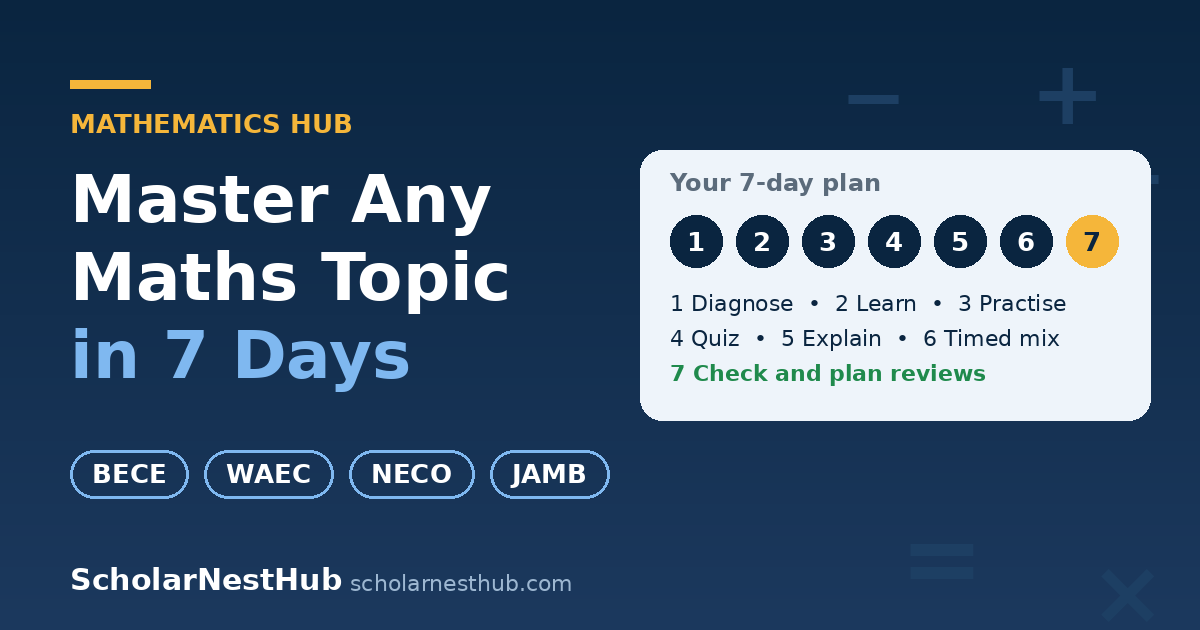
Let us be honest about the word “master”. A week of focused study will not make you an expert in everything, but it can give you a solid, exam-ready grasp of one topic and a plan for keeping it. This guide shows you how to master any maths topic in 7 days with a day-by-day routine built on study methods recommended in a U.S. Department of Education practice guide. Each day has one clear job, so you never waste time wondering what to do next.
If you are preparing for JAMB, you can pair this plan with our list of JAMB Mathematics questions that tend to repeat every year. Ready? Pick your topic and let’s begin.
What “Mastery” Means and Why This Plan Works
In this plan, mastering a topic means three things: you can explain the main idea in your own words, you can solve different kinds of questions without looking at notes, and you can spot and fix your own mistakes.
The plan draws on “Organizing Instruction and Study to Improve Student Learning”, a practice guide from the Institute of Education Sciences, part of the U.S. Department of Education (IES practice guide). Its expert panel recommends spacing learning over time, alternating worked examples with practice problems, quizzing yourself, and asking “why” questions. The panel rated the evidence for quizzing and for deep explanatory questions as strong, and the evidence for spacing and for alternating worked examples as moderate.
One honest caveat: the guide suggests reviewing material several weeks to several months after first learning it. A 7-day plan is much shorter, so we spread your practice across the week and add follow-up reviews afterwards.
Before Day 1: Set Up Your Week
Choose one topic and write your goal
Pick a single topic, such as linear equations, indices or simultaneous equations, and write one sentence for what success looks like. For example: “By Sunday I can solve any linear equation, explain each step and check my answer.”
Gather your tools
You need a notebook, your class notes or textbook, a set of practice or past questions on the topic, and a timer. As general guidance, plan 45 to 90 minutes a day, and shorter sessions on busy days are better than skipping.
Your 7-Day Plan at a Glance
Day
Focus
What you do
1
Diagnose and map
Try pre-questions cold; list subtopics and prerequisites
2
Learn the big idea
See it as a rule, a table, a graph or picture, and a story
3
Examples and practice
Alternate worked examples with problems you solve yourself
4
Closed-book quiz
Test yourself without notes, then mark and log errors
5
Explain the why
Answer “why” and “what if” questions aloud or in writing
6
Mixed and timed
Do varied questions against the clock
7
Check and plan reviews
Judge what stuck, fix gaps and schedule follow-ups
Days 1 to 3: Build the Foundation
Day 1: Diagnose and map the topic
Before you read a single page, write five questions you think you should be able to answer on this topic and try them cold. The IES guide calls these pre-questions and says they help you see what you do not yet know and wake up related knowledge. The panel rated this evidence as low, so treat it as a useful warm-up, not magic.
Next, list the subtopics and the skills they depend on. If you are tackling quadratic equations, for instance, your list might include expanding brackets, factorising and solving simple equations. Weak prerequisites are the quiet reason many topics feel impossible, so fix them first.
Day 2: Learn the big idea in more than one form
The IES guide recommends connecting abstract and concrete representations of the same idea. Take a simple example: a trader earns ₦200 for each bag sold. Show it four ways: as a rule, a table, a graph and a story.
Rule: y = 200x Table: 0 bags → ₦0, 1 → ₦200, 2 → ₦400, 3 → ₦600.
Graph: a straight line from the origin that rises ₦200 for every bag. Story: profit grows steadily with each bag.
Now change the idea to ₦300 per bag. The rule becomes y = 300x, the table jumps by 300 and the line gets steeper. Seeing the same structure in different forms helps you recognise it when an exam question looks unfamiliar. Label your sketches in words, because the guide also found that pairing pictures with short verbal descriptions helps learning.
Day 3: Alternate worked examples with practice
Do not read ten worked examples and then attempt ten problems. The IES guide recommends alternating between a solved example and a problem you do yourself, and it reports that students learn more this way. Study each step of the example, then solve a similar problem straight away.
Worked example: 3x + 4 = 19 → 3x = 15 → x = 5. Your turn: 4x + 3 = 27.
Answer: 4x = 24 → x = 6. Check: 4(6) + 3 = 27 ✓.
As you improve, use fewer worked examples and more solo problems. The guide advises this shift as your skill grows.
Days 4 to 6: Test, Explain and Stretch
Day 4: Test yourself without notes
Close the book and answer about ten questions from memory. According to the IES guide, quizzing with active recall is one of its strongest-supported methods, and taking a test usually helps learning more than spending the same time studying again. Then mark your work with the answers and write down each error with a short note on why it happened. The guide stresses that without correct-answer feedback, mistakes tend to come back.
Day 5: Explain the why
Today, ask deep questions: Why does this method work? What if the numbers change? How does this compare with another method? The IES panel rated this kind of explanation-building as strong evidence for deeper understanding, and it suggests thinking aloud or writing your explanations as you study.
Why does 3x + 4 = 19 become 3x = 15? Because subtracting 4 from both sides keeps the equation balanced.
What if it were 3x − 4 = 19? Add 4 to both sides: 3x = 23, so x = 23/3.
If you cannot explain a step, you have found a gap. Go back to Day 2 or 3 for that part only.
Day 6: Mix it up and go timed
Now practise with varied questions, different wording and different formats, as in a real paper. The guide notes that mixing up problems makes study harder but pays off in better learning. Set a timer, start with the questions you find easier, and watch the clock. The Iowa State University Academic Success Center gives the same advice in its guide to avoiding test-taking errors, and also suggests looking back at old exams to avoid repeating past mistakes (Iowa State ASC). For realistic practice, try the mock exams in our Math Hub.
Day 7: Check What Stuck and Plan Your Reviews
Today is your honest checkpoint. The IES guide describes a technique called the cue-only delayed judgment of learning. Look at a question without the answer, try to answer it, and rate from 0 to 100 how likely you are to get it right in a test tomorrow. Restudy anything you rated below 100. The guide explains that students often feel they know material right after studying, and that judging after a delay makes your self-assessment much more accurate. This evidence is rated low, but it fits with everything else in the plan.
Finish with a short mixed test, then schedule your follow-ups. Because the guide recommends spacing reviews by several weeks or more, put a short quiz on this topic in your calendar two weeks from now and again a month later. That is how a good week becomes lasting knowledge.
Common Mistakes That Waste Your Week
• Cramming on Days 1 and 2. Spreading practice across several days generally works better than one long session.
• Rereading instead of testing. The IES guide reports that testing yourself usually beats extra study time.
• Practising only what you already enjoy. Students often overestimate what they know after studying, so let quizzes show you the weak spots.
• Skipping feedback. Always check your answers, otherwise the same errors reappear.
• Choosing a topic that is too big. Split large topics into smaller ones and give each its own week.
Key Takeaways
• Mastery in a week means you can explain the topic, solve varied questions without notes and fix your own errors.
• Alternate worked examples with practice problems instead of reading examples in bulk.
• Quiz yourself closed-book and always check answers; testing beats rereading.
• Ask “why” and “what if” questions to build real understanding.
• Use a delayed self-check on Day 7, then schedule reviews after two weeks and a month.
• Take one topic at a time, and split big topics into smaller parts.
Frequently Asked Questions About Mastering Maths Topics in a Week
Can I really master a maths topic in 7 days?
You can reach a solid, exam-ready grasp of one topic in a week with focused daily work. Lasting mastery also needs follow-up reviews after the week ends.
How many hours a day should I study?
As general guidance, 45 to 90 focused minutes is a good target. Consistent daily sessions are better than one marathon.
What should I do if I get stuck on Day 3?
Go back to the prerequisite skill, study one more worked example, and then try a similar problem on your own. Ask your teacher for a hint if you are still stuck.
Can I use this plan for several topics at once?
Start with one topic so each day stays focused. Once it is stable, add short reviews of earlier topics while you begin the next one.
Why quiz myself instead of rereading?
The IES practice guide reports that testing yourself usually helps learning more than extra study time, especially when you recall answers from memory and then check them.
How do I know I have really understood a topic?
Try explaining each step and answering “why” questions without notes, then repeat the check a day later. If you can do both, the understanding is real.
How can I use this for WAEC or JAMB theory questions?
Use Days 3 and 6 for exam-style questions and practise writing clear working. Our guide on how to solve WAEC Mathematics theory questions fast shows how.
What if I only have three days?
Combine the plan: Days 1 and 2 first, then Days 3 and 4, then Days 5 to 7. Keep the closed-book quiz and the delayed self-check, because they reveal what you still do not know.
Will I forget the topic after the week?
Some forgetting is normal. Scheduled reviews after a couple of weeks and a month help the knowledge last.
Does the plan work for Further Mathematics?
Yes, with smaller chunks per week. See our article on overcoming the biggest difficulties in Further Mathematics for extra support.
Conclusion
Mastering a maths topic in a week is possible when every day has a clear job: diagnose, learn, practise, test, explain, stretch and check. Choose your topic today, block out the next seven days, and start with Day 1. When you are ready for exam-style practice, visit the ScholarNestHub Math Hub and put your new skills to the test.
Need help on your own project?
Browse ready-made materials or request a custom topic from a verified academic writer.