
How to Solve Word Problems: 15 Ways to Solve Any Word Problem Step by Step
Introduction
Word problems have a bad reputation. The mathematics inside them is often simple, yet many students freeze the moment a question turns into a story about a trader, a bus or two brothers sharing money. If that sounds familiar, the trouble is rarely your arithmetic. It is the translation from everyday English into mathematical language.
The good news is that translation is a skill, and skills can be trained. In this guide on how to solve word problems, you will learn 15 practical ways to read, plan, calculate and check any question, whether it comes from a class test, BECE, WAEC, NECO or JAMB. Each way comes with a short example you can try yourself.
The steps follow a well-known four-stage idea: understand the problem, devise a plan, carry it out, and look back. If you also want to work faster in written papers, pair this guide with our article on how to solve WAEC Mathematics theory questions fast. Ready? Let’s begin with the habit that saves the most marks: slowing down at the start.
Part 1: Understand the Problem Before You Pick Up Your Pencil
1. Read the whole problem twice
Read from the first word to the last before writing anything. The first read gives you the story and the question; the second picks up the details. Learning-centre guidance built on George Pólya’s four-step method makes the same point: don’t read half the question and assume you know what it wants (Tacoma Community College).
2. Find the question and underline it
Ask yourself, “What exactly am I being asked to find?” Underline it. Many lost marks come from solving for the wrong thing: you find a rectangle’s length when the question wanted its area, or you find x when the answer is 2x + 4. The Lorain County Community College guide also advises rereading until the end goal is clear (LLCC).
3. Write GIVEN and FIND statements
Turn the story into a short list. Write GIVEN and list the facts, then write FIND and state the target. This simple layout is recommended in the Tacoma guide, and it forces you to separate what you know from what you need.
Problem 1: The length of a rectangle is 3 m more than its width. Its perimeter is 34 m. Find the length.
GIVEN: length = width + 3; perimeter = 34 m. FIND: the length.
4. Draw a picture or diagram
Whenever the story involves shapes, distances, positions or groups, sketch it and label every part, marking unknowns clearly. Both college guides above recommend drawing. For Problem 1, draw a rectangle, label the short side w and the long side w + 3.
2(w + w + 3) = 34 → 2w + 3 = 17 → w = 7. The length is 7 + 3 = 10 m.
Part 2: Plan and Translate Words Into Mathematics
5. Use LET to name the unknown
Give the unknown a letter and say what it stands for. The Tacoma guide calls this a LET statement, and the unknown usually comes straight from your FIND line.
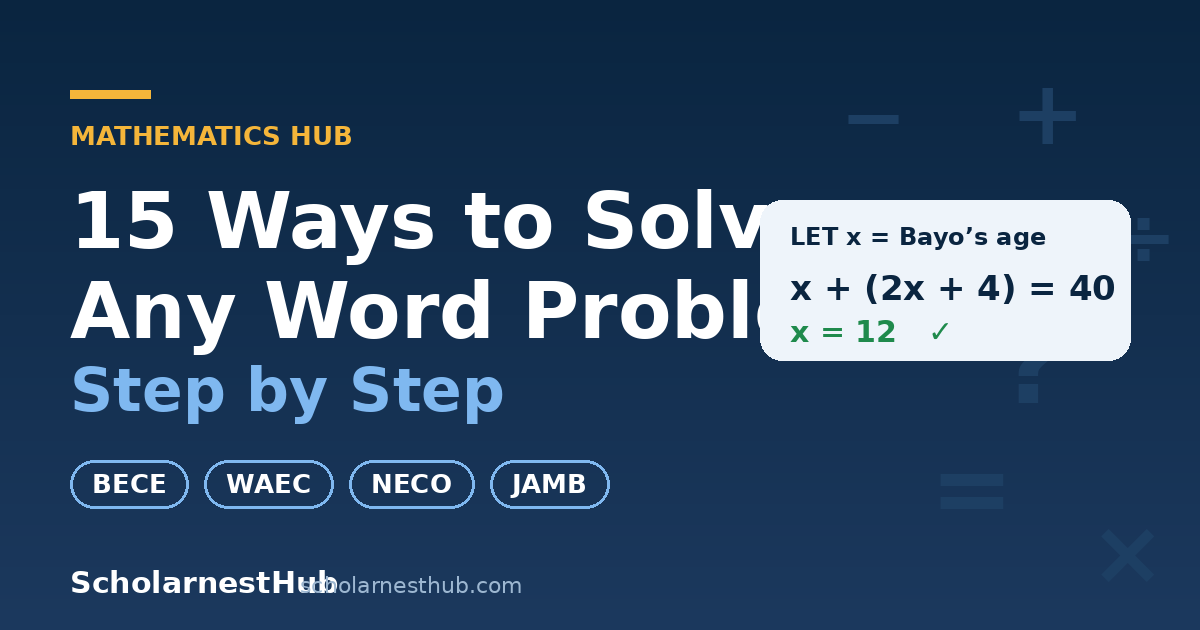
Problem 2: Ada is 4 years older than twice Bayo’s age. The sum of their ages is 40. Find Ada’s age.
LET x = Bayo’s age, so Ada = 2x + 4. x + (2x + 4) = 40 → 3x = 36 → x = 12.
The question asks for Ada, so Ada = 2(12) + 4 = 28 years.
6. Learn the keyword families (but treat them as hints)
Certain words usually point to certain operations. The Tacoma guide, which draws on a college mathematics textbook, lists many of them. Here is a quick summary in our own words:
Operation
Common clue words
Add
sum, plus, total, more than, increased by
Subtract
difference, minus, less than, decreased by
Multiply
product, times, of, double, triple
Divide
quotient, shared equally, divided into, among
Equals
is, was, equals, is equal to, yields
Be careful with order. “5 less than x” means x − 5, not 5 − x. Clue words guide you; they never replace understanding.
7. Translate one sentence at a time
Don’t try to convert the whole paragraph in one go. Work sentence by sentence and write the mathematical version beside each.
Problem 3: A trader buys a bag of rice for ₦45,000 and sells it at a 20% profit. Find the selling price.
Sentence 1: cost = ₦45,000. Sentence 2: profit = 20% of 45,000 = 0.20 × 45,000 = ₦9,000.
Selling price = 45,000 + 9,000 = ₦54,000.
8. Look for a similar problem you have solved before
Few word problems are truly new. Comparing a question with ones you already know how to solve helps you pick a method and boosts your confidence, as the Tacoma guide notes. Sharing money in a ratio, for example, is a pattern you will meet again and again.
Problem 4: Share ₦24,000 in the ratio 3 : 5. Total parts = 8; one part = 24,000 ÷ 8 = ₦3,000.
Shares: 3 × 3,000 = ₦9,000 and 5 × 3,000 = ₦15,000.
9. Organise the facts in a table or chart
When a problem has several people, times or stages, a table keeps everything visible. Age problems are the classic case.
Problem 5: A father is 3 times as old as his son. In 10 years he will be twice as old as his son. Find their present ages.
Now
In 10 years
Son
x
x + 10
Father
3x
3x + 10
3x + 10 = 2(x + 10) → 3x + 10 = 2x + 20 → x = 10. Son = 10 years, father = 30 years.
Part 3: Carry Out the Plan Accurately
10. Break big problems into smaller parts
Long, multi-stage questions feel scary because you see them as one giant task. Split them into small questions you can answer one by one, such as total cost first, then total income, then profit. The LLCC guide recommends breaking complex ideas into smaller parts for exactly this reason.
11. Work one step at a time and show every line
Write each step neatly, one under the other. Tidy working makes it easy to look back and find mistakes, and in theory questions it helps a marker follow your reasoning. Both guides stress writing out each step instead of doing everything in your head.
12. Keep your units consistent
Mixing minutes with hours, or centimetres with metres, is a quiet mark-killer. Convert first, then calculate.
Problem 6: A student walks 3 km in 45 minutes. Find the speed in km/h. 45 min = 0.75 h.
Speed = 3 ÷ 0.75 = 4 km/h.
13. Estimate before you calculate
A rough estimate gives you a target to compare your final answer against. Both guides suggest estimating the outcome. In Problem 3, 10% of ₦45,000 is ₦4,500, so 20% should be about ₦9,000. When the exact working gives ₦9,000, you know you are on track.
Part 4: Look Back and Keep Improving
14. Check that your answer is reasonable, labelled and correct
Ask three questions: Did I answer what was asked? Does the answer make sense? Did I label it with the right unit or meaning? The Tacoma guide gives sensible examples: a length cannot be negative, and a person’s height of twelve feet should make you suspicious.
Then test your answer against the original wording. The LLCC guide warns that if your own equation was written wrongly, substituting back into it will only confirm a wrong answer, so check against the words of the problem itself.
Check for Problem 2: Bayo = 12, Ada = 28. Is Ada 4 years older than twice Bayo’s age? 2(12) + 4 = 28 ✓. Do the ages sum to 40? 12 + 28 = 40 ✓.
15. Practise by problem type and ask for hints early
Word problems improve with deliberate practice, so group your practice by type: ages, ratios, percentages, speed, shapes, and so on. When you are stuck, the LLCC guide suggests asking a teacher or classmate for a hint rather than a full solution, then reworking the problem on your own. You can test yourself under exam-style conditions with the mock exams in our Math Hub.
Key Takeaways
• Read the problem twice and underline the actual question before you write anything.
• Use GIVEN, FIND and LET statements to turn a story into organised information.
• Draw a diagram or build a table whenever the problem has shapes, people, times or stages.
• Translate sentence by sentence, and treat clue words as hints, not rules.
• Estimate first, work one neat step at a time, and keep units consistent.
• Always look back: is the answer reasonable, labelled and true to the original words?
• Practise by problem type and ask for hints early instead of waiting until exam week.
Frequently Asked Questions About Solving Word Problems
What is the easiest way to solve word problems?
Follow four stages: understand the problem, devise a plan, carry it out, and look back. Starting with GIVEN and FIND statements makes the first stage much easier.
How do I know which operation to use?
Use clue words as hints, then ask how the known facts relate to the unknown. A quick sketch or table often makes the relationship obvious.
Why do I struggle with word problems when I am good at calculation?
Word problems test translation as well as arithmetic. Reading twice, writing GIVEN and FIND lines and practising one problem type at a time will build that translation skill.
Should I draw a diagram for every word problem?
Not every one, but draw whenever the story involves shapes, distances, positions or groups. A labelled picture often reveals the equation.
How can I solve word problems faster in exams?
Practise the same routine until GIVEN, FIND and LET become automatic, and keep your working tidy. Our guide on WAEC Mathematics theory questions has more speed tips.
How do I check my answer to a word problem?
Compare it with your estimate, confirm it is reasonable, label it, and test it against the original wording rather than only your own equation.
Are clue words always reliable?
No. Words like “less than” reverse the order of subtraction, so “5 less than x” is x − 5. Use them as hints and confirm with the meaning of the sentence.
What should I do if I get stuck?
Reread the question, redraw the diagram, and write the facts in a table. If you are still stuck, ask a teacher or classmate for a hint, then rework the problem yourself.
How often should I practise word problems?
Short, regular sessions on one problem type at a time work better than one long cramming session. You can also review JAMB Mathematics questions that tend to repeat as part of your routine.
Do these steps work for Further Mathematics?
Yes. The same understand-plan-solve-check approach applies, only with more advanced content. See our article on overcoming the biggest difficulties in Further Mathematics.
Conclusion
Solving any word problem comes down to a repeatable routine: understand, plan, calculate and check. Pick three of the 15 ways above, apply them to your next homework question, and add more as they become natural. Ready to practise? Head to the ScholarnestHub Math Hub and put these steps to work on exam-style questions today.
Need help on your own project?
Browse ready-made materials or request a custom topic from a verified academic writer.