
Primary vs. Secondary Sources: What Every Researcher Should Know
Every strong research project rests on a foundation of credible evidence, and knowing the difference between primary and secondary sources is one of the first skills every serious researcher needs to master. Confusing the two — or misusing them — is one of the most common reasons supervisors send project chapters back for revision.
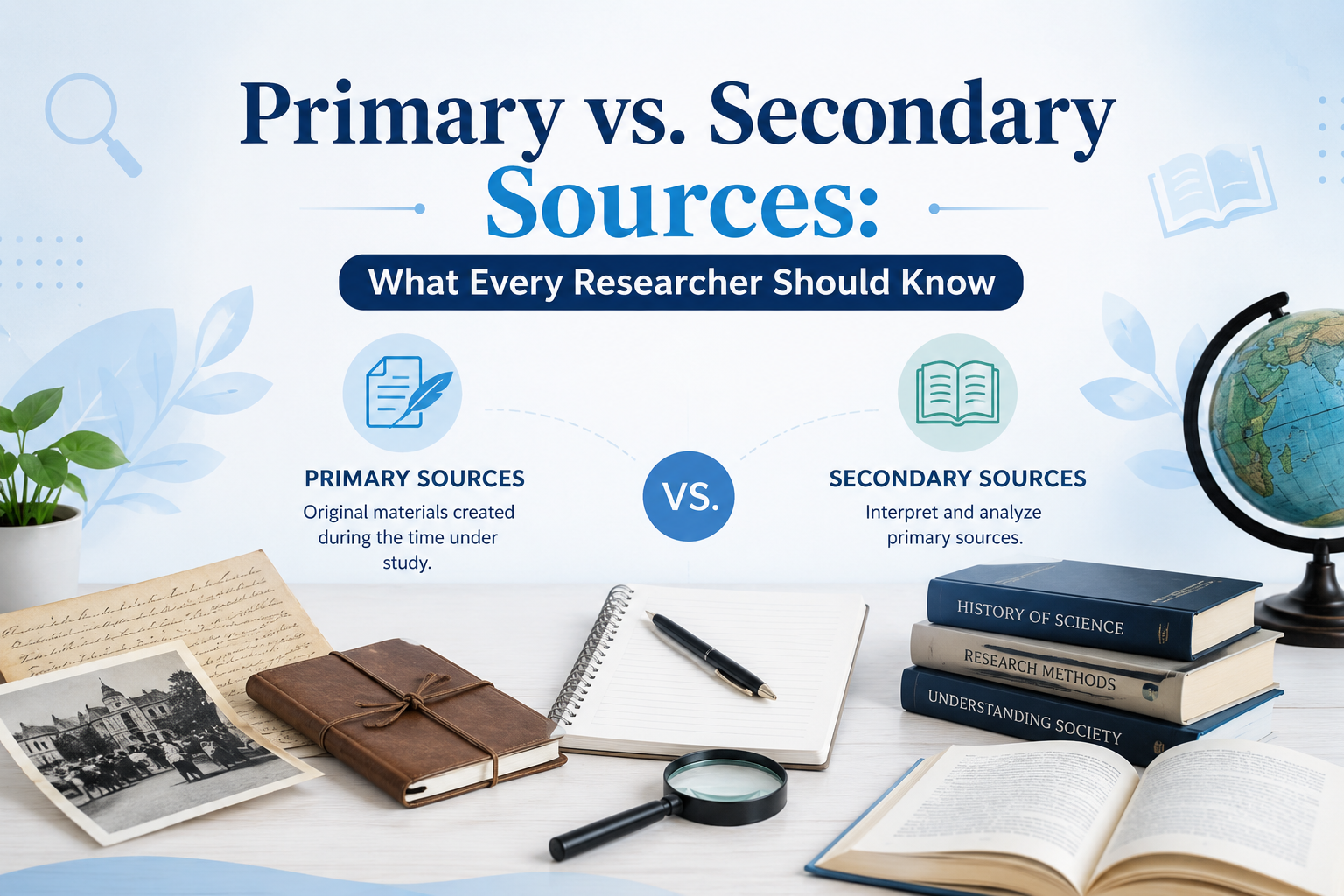
A primary source is firsthand, original evidence — a dataset you collected yourself, a historical document, an interview transcript, a court ruling, or a lab experiment's raw results. A secondary source, by contrast, analyzes, interprets, or comments on primary material — a textbook chapter, a journal review article, or a scholar's critique of someone else's findings.
This guide breaks down exactly what separates the two, when to use each one, and how to avoid the source-selection mistakes that quietly weaken otherwise solid research. Whether you're just beginning to choose a research topic or already deep into your literature review, understanding this distinction will make your citations more credible and your argument more convincing.
What Is a Primary Source?
A primary source is original material produced at the time of an event or as direct evidence of a phenomenon, without another author's interpretation standing between you and the raw information. In other words, primary sources are as close to the original event, data, or expression as a researcher can get.
If you conducted a survey, ran an experiment, or interviewed a subject-matter expert yourself, that raw data is a primary source. If you're studying a historical event and use a newspaper report from that exact period, a government record, or a personal letter, those count as primary sources too — the kind of firsthand material collections such as the Library of Congress make widely accessible for research purposes.
Common Examples of Primary Sources
• Original research data (surveys, experiments, field observations)
• Government records, statutes, and court rulings
• Diaries, letters, speeches, and interviews
• Photographs, artworks, and artifacts from the period studied
• Patents, technical reports, and original manuscripts
What Is a Secondary Source?
A secondary source discusses, analyzes, summarizes, or builds on primary material rather than presenting it firsthand. Secondary sources add a layer of interpretation — which is valuable, but means the information has already passed through someone else's analytical lens.
Most of the literature review section in an undergraduate or postgraduate project is built from secondary sources: they help you understand what other researchers have already found, identify gaps in the existing body of knowledge, and position your own study within a wider academic conversation.
Common Examples of Secondary Sources
• Textbooks and academic reference books
• Journal review articles and meta-analyses
• Biographies and historical analyses written after the fact
• News commentary or opinion pieces discussing an event
• Documentaries that interpret historical footage or data
Why the Distinction Matters in Academic Research
Examiners and supervisors pay close attention to how a student uses evidence, and mixing up primary and secondary sources — or relying too heavily on one type — is a common reason chapters get flagged during defense. Strong research typically triangulates: it uses secondary sources to establish context and identify gaps, then draws on primary evidence to generate original findings. If you're still building this kind of research discipline, our roundup of 15 skills every university student must learn before graduation covers several habits that make source evaluation easier.
Overreliance on secondary sources alone can make a project read as a summary of other people's work rather than an independent contribution, which is precisely what most undergraduate and postgraduate research is expected to avoid.
How to Tell Primary and Secondary Sources Apart
A simple way to test a source is to ask one clear question: is this the original evidence, or is it someone commenting on the evidence? If it's the raw data, document, or firsthand account, it's primary. If it's an analysis, interpretation, or summary built on top of that raw material, it's secondary.
It also helps to remember that classification can shift depending on your research question. A newspaper article, for example, is a primary source if you're studying how the media covered an event at the time, but a secondary source if you're using it simply to summarize background facts about something that happened. Style and citation guides such as Purdue OWL are a useful reference point when you're unsure how a specific source should be classified or cited.
When Should You Use Primary vs Secondary Sources?
Most strong academic projects use both, but in different places and for different purposes.
• Use primary sources when you need original evidence to support your own analysis, when your methodology chapter requires firsthand data, or when you're directly testing a hypothesis.
• Use secondary sources when you're building your literature review, establishing theoretical frameworks, or showing how your study relates to existing scholarship.
A well-balanced project typically leans on secondary sources early — in the background and literature review — then shifts toward primary evidence in the methodology, results, and discussion chapters.
Tertiary Sources: The Often-Forgotten Third Category
Beyond primary and secondary sources, researchers also encounter tertiary sources — materials that compile or index both primary and secondary sources, such as encyclopedias, bibliographies, and citation databases. Tertiary sources are useful for getting a broad overview of a topic early in your research, but they are rarely appropriate to cite directly in a serious academic project. Once you've used them to orient yourself, you can move on to browse project topics across departments to see how other researchers have sourced and structured similar studies.
Practical Tips and Common Mistakes to Avoid
• Don't treat a secondary source's summary of data as if it were the primary data itself — always trace claims back to the original source where possible.
• Avoid citing tertiary sources like general encyclopedias as academic evidence; use them only to orient yourself before finding stronger primary or secondary material.
• Keep a source log as you research, noting whether each item is primary or secondary and why — this saves significant time when writing your methodology and literature review.
• Watch for sources that blend both categories, such as an annotated historical document, and cite the specific portion you're actually using.
Don't assume a source is credible just because it's primary — primary sources can still be biased, incomplete, or unrepresentative, and should be evaluated critically like any other evidence, a point reinforced by the U.S. National Archives in its guidance on analyzing primary source material.
• Cross-check your interpretation of a primary source against established secondary literature to avoid drawing conclusions that specialists in the field would consider unsupported.
Conclusion
Understanding the difference between primary and secondary sources isn't just an academic technicality — it's one of the clearest signals to your supervisor or examiner that you know how evidence actually works. Secondary sources give your project context and theoretical grounding; primary sources give it originality and credibility. The strongest research projects use both deliberately, not interchangeably.
As you move from selecting a topic to writing your full project, it's worth revisiting how your source choices support each chapter — not just what you cite, but why. If you're still refining your project structure, our guide on how to defend your final year project successfully covers how examiners evaluate the strength and originality of the evidence you present.
Frequently Asked Questions
1. What is the main difference between primary and secondary sources?
A primary source presents original, firsthand evidence, while a secondary source interprets, analyzes, or summarizes that evidence after the fact.
2. Can a source be both primary and secondary?
Yes. Classification often depends on how you're using it — a source can function as primary evidence for one research question and as secondary background for another.
3. Are textbooks primary or secondary sources?
Textbooks are almost always secondary sources, since they summarize and interpret research and events rather than presenting original data or firsthand accounts.
4. Is a journal article a primary or secondary source?
It depends on the article. An original research study reporting new data is a primary source, while a literature review or meta-analysis discussing multiple studies is a secondary source.
5. Why do supervisors care about the primary vs secondary source distinction?
Because it signals whether a student understands how to build an original argument versus simply summarizing existing work — a key expectation in undergraduate and postgraduate research.
6. How many primary sources should a research project include?
There's no fixed number; it depends on your methodology and discipline. What matters more is that your primary evidence is directly relevant and rigorously analyzed, not just present for its own sake.
7. What are tertiary sources, and should I cite them?
Tertiary sources, like encyclopedias and bibliographies, compile primary and secondary material for general orientation. They're useful early in research but are rarely appropriate to cite as academic evidence.
8. Can secondary sources be biased?
Yes. Since secondary sources involve interpretation, they can reflect the author's perspective or theoretical lens, which is why it's important to consult multiple secondary sources rather than relying on just one.
9. How do I decide which type of source to use in my literature review versus my methodology chapter?
Literature reviews typically rely on secondary sources to establish context and existing scholarship, while methodology and results chapters usually depend on primary sources or original data you've collected.
10. What's the easiest way to check if a source is primary or secondary?
Ask whether the source presents original evidence firsthand or comments on and interprets evidence gathered by someone else — the former is primary, the latter is secondary.
Need help on your own project?
Browse ready-made materials or request a custom topic from a verified academic writer.