
Questionnaire vs. Interview: Which Data Collection Method Is Best for Your Research?
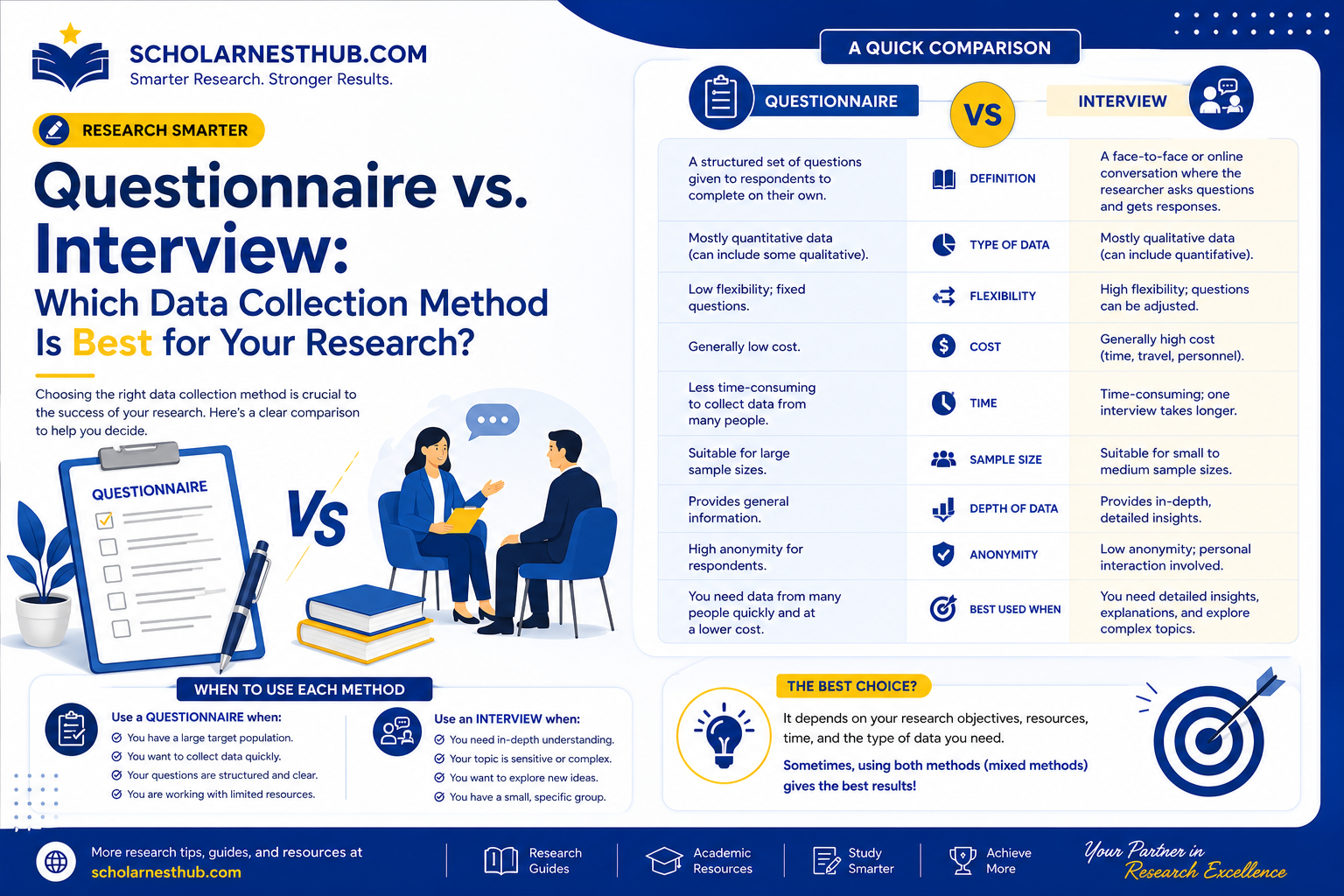
One of the earliest decisions in your methodology chapter — and one of the most consequential — is how you'll actually collect your data. Choose a questionnaire when your study needs a personal, in-depth interview, and you'll end up with a thin data set that doesn't hold up under scrutiny. Choose an interview when you needed breadth across a large population, and you'll burn weeks of fieldwork you never had time for. The good news is that the decision usually comes down to a handful of clear factors, not guesswork.
This guide compares both methods side by side so you can make the right call for your specific research questions. If you're still finalising your topic, our Project Topics page has ideas across several departments to help you settle on a direction before you commit to a data collection method.
What Each Method Actually Involves
Questionnaires
A questionnaire is a structured, self-administered set of written questions, typically delivered on paper or through an online form, that respondents complete on their own. It's fast to distribute at scale and, according to this comparison of questionnaires and interviews, offers a more structured and efficient way to gather data from a larger number of respondents, even though it may not capture the same depth as a live conversation.
Interviews
An interview involves direct, real-time interaction between researcher and respondent — face-to-face, by phone, or via video call — and can be structured, semi-structured, or unstructured. This live format lets you ask follow-up and probing questions that dig deeper into a respondent's answers, which is the main reason interviews are favoured for exploratory or qualitative work where you're trying to understand why something happens, not just how often.
Questionnaire vs. Interview: A Side-by-Side Comparison
Factor Questionnaire Interview
Data type Mostly quantitative, structured Mostly qualitative, in-depth
Sample size Large samples, wide reach Small samples, resource-heavy
Flexibility Fixed once distributed Can probe and follow up live
Analysis effort Faster, statistical Slower, thematic/coding
Cost & time Lower per respondent Higher per respondent
Best for Testing hypotheses across a population Exploring experiences in depth
The Case for Questionnaires
• Reach: they can cover a geographically dispersed sample without travel costs, which is a major reason questionnaires suit nationwide or cross-institutional studies.
• Speed at scale: hundreds of responses can be collected and analysed in the time it might take to schedule a dozen interviews.
• Anonymity: self-administered questionnaires give respondents confidence to answer sensitive questions honestly, since responses are recorded in the respondent's own words rather than filtered through an interviewer.
• Straightforward analysis: closed-ended items translate directly into statistics — means, frequencies, correlations — which pairs naturally with hypothesis-testing research designs.
The trade-off is depth. Once a questionnaire is distributed, you can't adapt it based on what respondents are telling you, and there's no opportunity to clarify a confusing answer or probe further.
The Case for Interviews
Interviews collect complete information with a greater level of understanding than a fixed-choice instrument can offer, and they allow the researcher more control over the order and flow of questions as the conversation develops. This flexibility means you can introduce follow-up questions or adjust your approach based on earlier answers — something that this data collection methods guide notes is simply not possible once a questionnaire has already been distributed.
The trade-off here is scale and effort. Interviews are considerably more time-consuming to conduct and transcribe, harder to standardise across multiple interviewers, and the resulting qualitative data takes far longer to code and analyse than a spreadsheet of Likert-scale responses.
Matching the Method to Your Research Design
Choose a Questionnaire When...
• Your study is quantitative and you're testing a hypothesis across a defined population.
• You need a large, geographically spread sample.
• Your budget and timeline are limited.
• The topic is sensitive and anonymity will improve honesty.
Choose an Interview When...
• Your study is qualitative or exploratory in nature.
• You need to understand motivations, experiences, or context in depth.
• Your sample size is naturally small (key informants, experts, case studies).
• You expect to need follow-up questions to fully understand responses.
Or Use Both: Mixed-Methods Designs
Many strong undergraduate and postgraduate projects use both instruments — a questionnaire to establish patterns across a larger sample, followed by a small number of interviews to explain or add depth to the statistical findings. If you go this route, make sure your methodology chapter clearly justifies why each method was chosen for its specific role, rather than treating the mix as an afterthought. Our guide to designing an effective research questionnaire is a useful companion if the quantitative half of your study is a questionnaire.
Practical Considerations Beyond the Data Itself
A few practical factors often decide the question in real student projects, beyond the theoretical advantages of each method:
• Access to respondents: can you realistically get face time with your target respondents, or is an online questionnaire the only feasible route?
• Supervisor and department expectations: some departments favour questionnaire-driven quantitative projects; check before committing to an interview-heavy design.
• Your own analysis skills: thematic coding of interview transcripts requires a different skill set than running descriptive or inferential statistics on survey data.
• Timeline: interviews, including scheduling, conducting, and transcribing, typically take considerably longer per respondent than a questionnaire does.
Key Takeaways
• Questionnaires suit large-scale, quantitative research where breadth and statistical analysis matter most.
• Interviews suit smaller-scale, qualitative research where depth, context, and flexibility matter most.
• Interviews allow follow-up and adaptation mid-study; questionnaires are fixed once distributed.
• Mixed-methods designs can combine both, provided each method's role is clearly justified.
• Practical factors — access, timeline, supervisor expectations, and your own analysis skills — often matter as much as the theoretical trade-offs.
Frequently Asked Questions
Can I use both a questionnaire and interviews in the same project?
Yes — this is a common mixed-methods approach, using a questionnaire for breadth and interviews for depth. Just make sure your methodology chapter explains why each method was chosen for its specific purpose.
Which method is easier for a final year project?
Questionnaires are generally quicker to administer and analyse at scale, which is why they're more common in undergraduate quantitative projects. Interviews demand more time for scheduling, conducting, and transcribing, so they suit smaller, more focused qualitative studies.
Do interviews always produce better data than questionnaires?
Not necessarily — "better" depends on your research question. Interviews produce richer, more contextual data for a small sample; questionnaires produce broader, more generalisable data for a large sample. Neither is universally superior.
How many interview participants do I need?
There's no fixed number; qualitative studies often work with a much smaller sample than quantitative ones, guided by when responses start repeating similar themes rather than a target statistic. Check your department's expectations for your specific research design.
Is a questionnaire the same as a survey?
Not exactly — a survey is the broader research approach, while a questionnaire is the specific instrument (the set of questions) used within that approach. In practice, though, the terms are often used interchangeably in student research.
What's the biggest mistake students make when choosing between these methods?
Picking a method based on convenience rather than fit with the research question — for example, defaulting to a questionnaire because it's faster, even when the research question is genuinely exploratory and needs interview depth. Once you've settled on your method, our guide to designing an effective research questionnaire can help you build it properly.
Can interview data be analysed statistically?
To a limited extent — structured interviews with closed questions can be quantified, but most interview data is analysed thematically or through qualitative coding rather than statistical tests.
Conclusion
Neither method is inherently better — the right choice depends entirely on whether your research question calls for breadth or depth, and what resources you realistically have for data collection. Match the method to your research design first, then work out the practical logistics. If you'd like expert input on choosing and structuring your data collection approach, our Hire a Writer service can help, or browse available project topics to get started.
Need help on your own project?
Browse ready-made materials or request a custom topic from a verified academic writer.