
The 30-Day Revision Plan: What to Study Each Week
INTRODUCTION
Thirty days sounds short until you plan it properly. Then it becomes four clear weeks, each with its own job. If your WAEC, JAMB, NECO or BECE exam is a month away, a 30-day revision plan is the difference between random studying and steady progress. This guide shows what to study each week, how to split your time, and how to avoid the mistakes that waste the last weeks before an exam.
You will not learn a whole syllabus from scratch in a month, and you do not need to. The goal is to find what you already know, repair what you do not, practise under exam conditions, and arrive on exam day rested. You can find more exam guides on the Scholarnesthub blog, and the plan below works for any subject, from Mathematics to Literature.
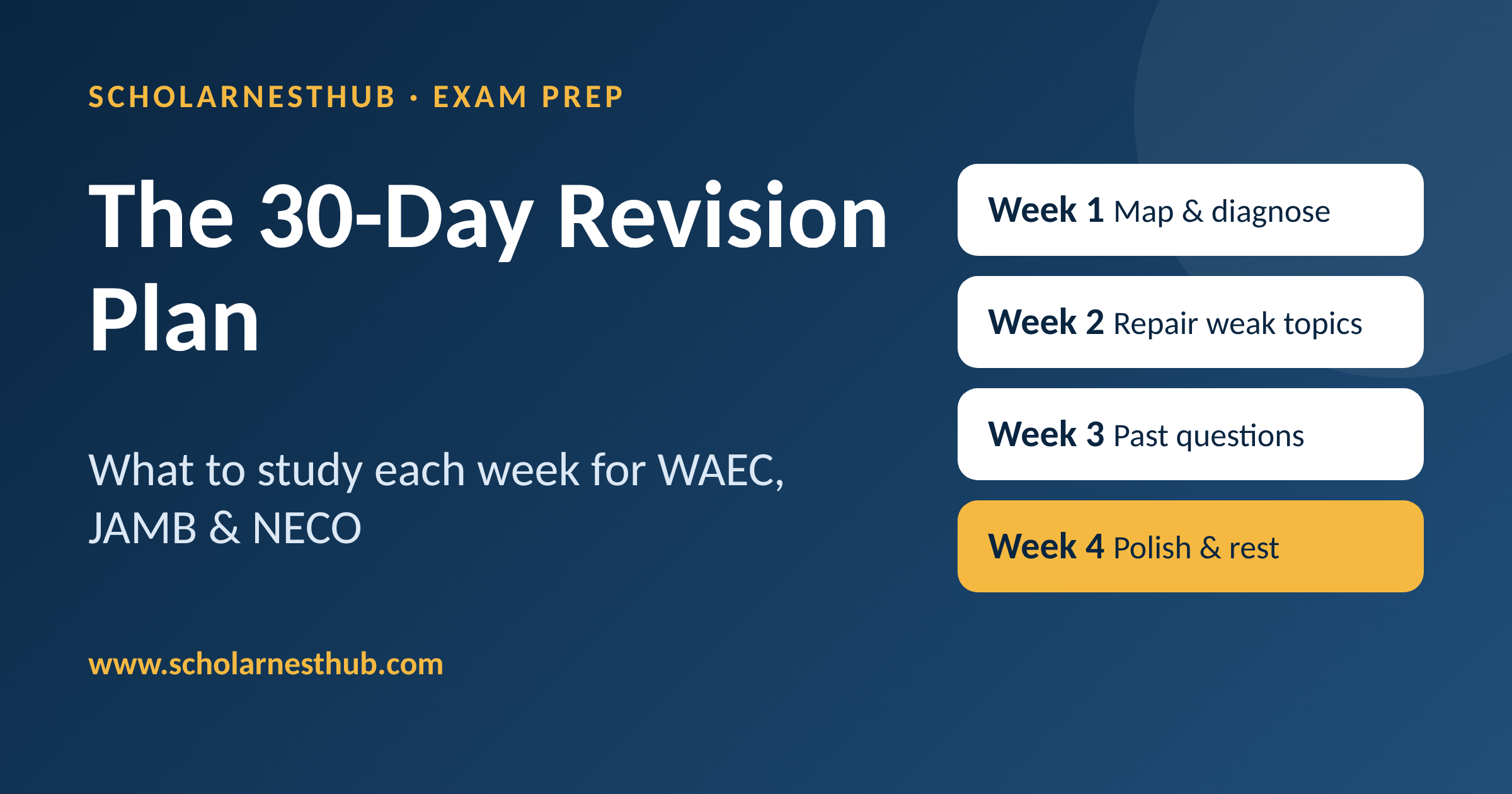
Here is the plan in one line: map in Week 1, repair in Week 2, practise in Week 3, polish in Week 4.
The 30-Day Revision Plan: What to Study Each Week
Before Day 1: Set Up Your Plan
Spend one evening on setup. It saves hours later.
Write down every subject and exam date
List each subject, its exam date and its paper format. Check how many papers there are, whether there is an objective section, and whether practical or oral parts exist. University academic-skills guides recommend checking each exam's format, question types and dates before you plan, and the University of Melbourne exam revision page makes this the first step.
Work backwards from the exam
Count back from the first paper. Block out meals, sleep, chores and family duties first, then place study time in what remains. Both the University of Melbourne and the University of Sheffield advise working backwards from exam dates, and Sheffield adds that you should leave spare time for the unexpected. In Nigeria, that may mean a power cut, a long journey or a family event.
Choose a simple revision tracker
Use a notebook page with three columns: topic, confidence and date revised. After each session, mark the topic as good, okay or needs work. This confidence-rating idea comes from the Melbourne guidance, and it is the engine of the whole plan.
Week 1 (Days 1–7): Map the Syllabus and Find Your Weak Spots
Week 1 is about honesty. You are not trying to master anything yet. You are finding out where you stand.
Get the syllabus for each subject
Use the official syllabus for your exam board and turn every topic into a checklist line. A topic you cannot explain without your notes is not yet revised.
Take a diagnostic test
Do one past paper, or one section of it, for each subject. Do not worry about the score. Mark it and sort every topic into three groups:
• Strong: you answered correctly and could explain why.
• Shaky: you got it right by luck or took too long.
• Weak: you could not attempt it or got it wrong.
Rank subjects by priority
Give more time to weak topics that carry many marks and to subjects with early exam dates. Sheffield advises being selective, putting the most important material and the topics you know least well first. A simple split is 50 per cent of your time on weak topics, 30 per cent on shaky ones and 20 per cent on strong ones.
Sample Week 1 schedule
• Days 1–2: Gather syllabi, notes and past questions. Build your tracker.
• Days 3–5: Diagnostic tests, one or two subjects a day.
• Days 6–7: Mark, sort topics, and rewrite your plan using what you found. Take a rest period.
Week 2 (Days 8–14): Repair Weak Topics with Active Revision
Now you fix what you found. The big shift here is from reading to recalling.
Stop only re-reading
Re-reading feels productive but tests nothing. Melbourne's guide says re-reading is a first step, but you should aim to recall, transform, apply or explain the material. Try these methods:
• Cover and recall: close your notes and write what you remember, then check.
• Teach someone: explain a topic aloud to a friend or sibling.
• Rework notes: turn a chapter into a mind map, flow chart or one-page summary.
• Flashcards: condense formulae, definitions and keywords, a method Sheffield also suggests.
Use short sessions
Frequent, shorter sessions beat long marathons. Melbourne suggests sessions of about 50 minutes, while Sheffield describes the Pomodoro technique: about 25 minutes of focus, then a 5-minute break. Try either and keep the one that suits you.
Study weak topics at your best time of day
Put the hardest topics in the hours when you think most clearly. For many students that is early morning, but this is general advice, so test your own energy for a few days.
How to split a day
• Session 1 (morning): one weak topic, active recall.
• Session 2 (afternoon): a second subject, practice questions on that topic.
• Session 3 (evening): a light review of the day, then flashcards.
Maths and science students should solve problems rather than read worked solutions. English and Literature students should write short answers, not just reread notes.
Week 3 (Days 15–21): Practise with Past Questions Under Exam Conditions
Week 3 turns knowledge into exam skill. Many students know the content but lose marks to timing, misreading and weak answer structure.
Do timed past papers
Practise the same question types you will meet. Melbourne recommends past papers where they exist, and suggests writing your own questions where they do not. It also advises simulating exam conditions: time yourself, use only permitted materials and, if you can, study at the same time of day as the exam.
Self-mark honestly
Sheffield recommends marking your own answers and checking which marks each answer earns. Look at the marking approach for each type of question, then write down the exact reason for every lost mark: wrong concept, careless slip, poor timing or unclear writing.
Build an error log
Keep a short list of recurring mistakes, such as sign errors in algebra, missed units in physics or weak paragraph openings in essays. Review it each evening. Your error log becomes your personal revision guide.
Sample Week 3 schedule
• Days 15–18: One full timed paper per day, alternating subjects.
• Days 19–20: Review errors and re-study the topics that caused them.
• Day 21: Rest, or light flashcards only.
Week 4 (Days 22–30): Consolidate, Revisit and Rest
The last stretch is for strengthening, not cramming.
Revisit everything in a spaced way
Spaced revision means you come back to material at increasing gaps. Melbourne describes reviewing within a day, again a day later, again a week later, then every two to three weeks. In a 30-day plan you will compress that, so revisit Week 1 topics in Week 3 and again in Week 4, testing yourself before looking at your notes.
Shift to mixed practice
Early in revision, study one topic at a time. Later, mix topics in the same session, because the exam will not present them in order. Melbourne describes this as blocking for new material and interleaving later, then a final brush-up. Mixed practice also shows you whether you can choose the right method, not just follow it.
Final summary sheets
For each subject, write one page of key formulae, definitions, dates, diagrams and the mistakes from your error log. Keep these for the last 48 hours.
Protect your sleep in the final days
Avoid all-night cramming. Sheffield says that a good night's sleep will be far more helpful than last-minute cramming, and notes that tiredness and stress make it harder to retain information. Eat properly, drink water and keep a normal routine.
Sample Week 4 schedule
• Days 22–25: Mixed practice, spaced review of every subject.
• Days 26–28: Final timed papers for your hardest subjects, then targeted repair.
• Days 29–30: Summary sheets only, light review, early bedtime. Prepare your registration documents, pens, calculator and route.
A Sample Weekly Timetable You Can Copy
Adapt this to your own subject list.
• Monday to Friday: three sessions of 50 minutes with breaks between them.
• Saturday: one timed paper and marking.
• Sunday: light review, planning, and a proper rest.
Include breaks and a full day off each week. Sheffield recommends planning regular breaks, including whole days off, so that revision stays focused.
Common Mistakes to Avoid in a 30-Day Plan
• Starting with your favourite subject only. Weak subjects need the first hours.
• Copying notes endlessly. Copying is not recall.
• Skipping past questions. Questions teach you the exam style.
• Ignoring the timetable when life interrupts. Use your spare buffer days instead of giving up.
• Revising only on the last night. Spread the work across the month.
If you are also writing a project or long essay alongside exams, visit the ScholarNestHub homepage to find resources for your next step.
Key Takeaways
• Week 1: map the syllabus, test yourself and rank your weak topics.
• Week 2: repair weak areas with recall, teaching and short sessions.
• Week 3: do timed past papers, mark yourself and keep an error log.
• Week 4: revisit everything, mix topics, and protect your sleep.
• Plan backwards from the exam date and leave buffer time.
• Choose active methods over passive re-reading.
Frequently Asked Questions
Is 30 days enough to revise for WAEC, JAMB or NECO?
It can be enough to improve results if you use the time well. You will not cover everything from scratch, so focus on high-value and weak topics and practise past questions.
How many hours should I study each day?
There is no single right number. Start with three focused sessions on school days, then adjust. Quality and regular breaks matter more than long hours.
How many subjects should I revise in one day?
Two or three is usually manageable. Switching between them can keep you fresh, as long as each session has a clear goal.
What should I do if I am behind on the syllabus?
Prioritise by marks and weakness. Skip rarely tested topics if you must, and use your tracker to review what remains, and browse the study guides on Scholarnesthub for quick refreshers.
Should I study at night or in the morning?
Use the time when you concentrate best. Whatever you choose, keep your sleep regular, especially in the final week.
How do I use past questions properly?
Time yourself, work without notes, mark honestly and study the reason for every lost mark. Doing papers without learning from them does little.
Is group study useful?
Yes, when it is active. Both Melbourne and Sheffield suggest quizzing each other and explaining topics to one another. Keep groups small and focused.
Can I use this plan for the BECE?
Yes. Shorten the sessions, use simpler summary sheets and ask a parent or teacher to help check your tracker.
What if I lose motivation in Week 2 or 3?
Shrink the task. Study for one session, tick it off and reward yourself. Sheffield suggests planning rewards, and breaks and days off help you keep going.
What should I do on the day before the exam?
Read your summary sheets, check your documents and materials, and go to bed early. Do not start new topics.
Conclusion
A 30-day revision plan works because it gives every week a purpose: map, repair, practise and polish. Print your timetable, set up your tracker tonight, and begin tomorrow. For more study guides and exam help, explore the Scholarnesthub blog and keep building your routine one session at a time.
Need help on your own project?
Browse ready-made materials or request a custom topic from a verified academic writer.