
Undergraduate Thesis vs. Graduate Dissertation: Key Differences
If you've ever heard a final-year student and a master's candidate both refer to their "project" and wondered whether they're doing the same thing, you're not alone. The terms thesis and dissertation get used loosely — sometimes interchangeably — across universities, countries, and even departments within the same school. But they describe genuinely different levels of academic work, with different expectations for originality, length, supervision, and defense.
Understanding these differences matters long before you start writing. It shapes how you choose a research topic, how much original data you'll need to collect, and how your final defense will be structured. This guide breaks down exactly where an undergraduate thesis and a graduate dissertation diverge — and where regional terminology can trip you up.
Whether you're wrapping up a final-year project or just starting a master's or doctoral program, knowing what's actually expected of you will save you from over- or under-preparing for what's ahead.
Thesis vs. Dissertation: Where the Confusion Comes From
Part of the confusion is genuinely regional. In the United States, a thesis is typically the final research paper for a master's degree, while a dissertation refers to the doctoral-level project. In the United Kingdom and in many Nigerian and Commonwealth universities, the usage is often reversed or applied differently — an undergraduate final-year project is commonly called a thesis, while postgraduate research at the master's or PhD level is called a dissertation.
Grand Canyon University's comparison of the two terms confirms that this reversal is a recognised source of confusion between countries, so the first thing to check is not which word your university uses, but what level of research your specific program actually requires.
For this guide, we'll use the common convention followed across most Nigerian and Commonwealth universities: an undergraduate thesis is the final-year research project completed for a bachelor's degree, and a graduate dissertation refers to postgraduate research completed at the master's or doctoral level.
Key Differences at a Glance
Purpose and Academic Level
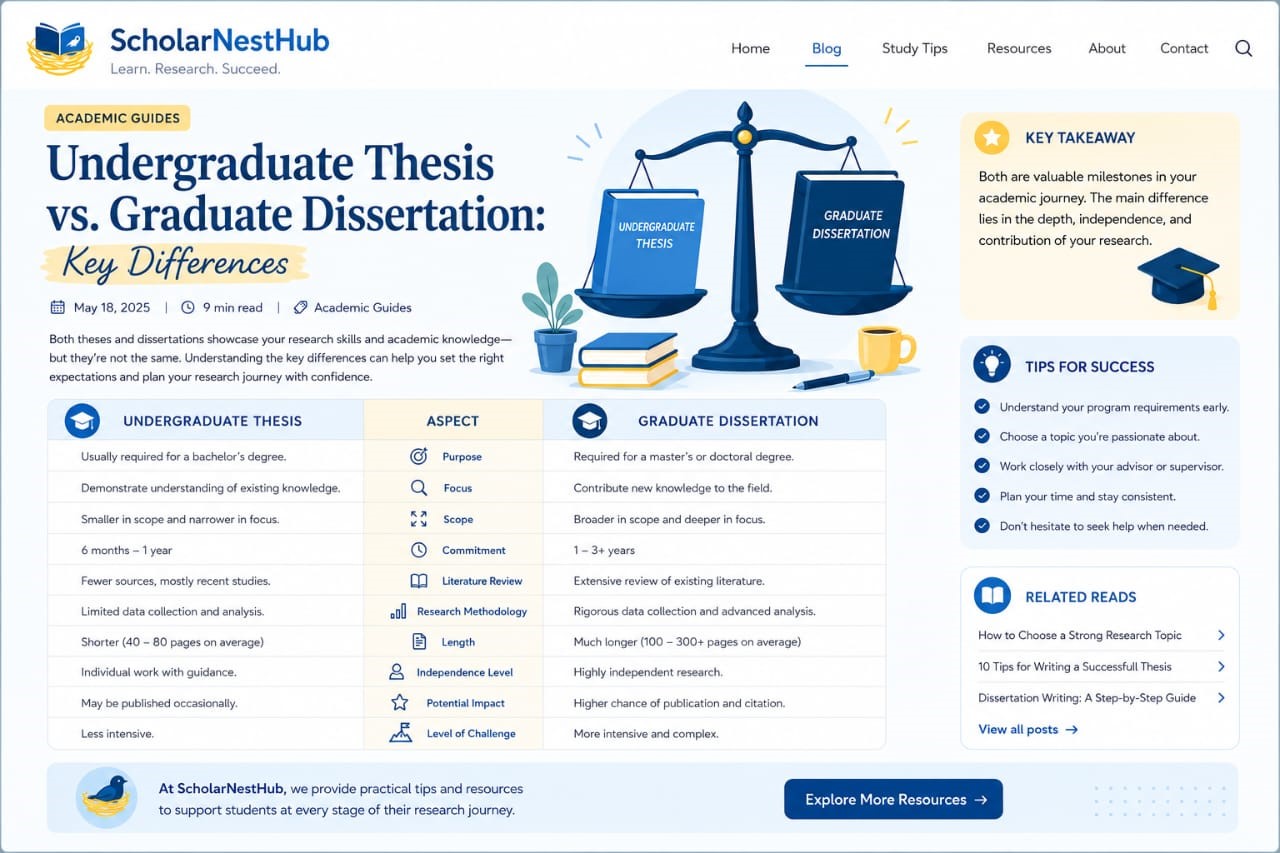
An undergraduate thesis is designed to demonstrate that you can apply what you've learned throughout your degree to a real research problem. It tests your ability to review literature, choose an appropriate method, and communicate findings clearly. A graduate dissertation goes further: it's expected to contribute something new to the field, not just demonstrate competence with existing knowledge.
Length and Depth
Undergraduate theses are typically shorter and more tightly scoped, often focused on a single research question within a familiar framework. National University's comparison of thesis and dissertation requirements notes that dissertations require added complexity — original data collection, an extended literature review, and a significantly longer final document — compared with a standard thesis.
Originality of Research
This is arguably the sharpest dividing line. An undergraduate thesis can rely heavily on existing literature, applying established theories or methods to a specific case or dataset. A graduate dissertation — especially at the doctoral level — is expected to generate genuinely original knowledge: a new model, a previously untested hypothesis, or a fresh angle that other researchers haven't yet explored.
Supervision and Committee Structure
Undergraduate students usually work with a single supervisor who guides them through the process and signs off on the final submission. Graduate dissertations typically involve a full committee — often including external examiners — who evaluate the work's methodology, contribution, and rigor far more critically.
The Defense Process
Both levels usually end with an oral defense, but the stakes differ. An undergraduate defense tends to be a shorter, department-level presentation. A graduate dissertation defense is a more rigorous, sometimes public examination in front of a panel of specialists. If you're preparing for either, our guide to defending your final year project walks through how to prepare for the kind of questioning you'll face.
Structural Differences in Practice
Undergraduate Thesis Structure
• Introduction and background of the problem
• Literature review, usually more concise than at the graduate level
• Methodology, often using established or simplified approaches
• Results and discussion based on a narrow, well-defined dataset
• Conclusion and recommendations
Graduate Dissertation Structure
• Introduction with a clearly articulated research gap and contribution to knowledge
• Extensive literature review positioning the work within ongoing scholarly debate
• Detailed methodology, frequently involving original data collection or experimentation
• In-depth results, analysis, and discussion of implications for the field
• Conclusion addressing theoretical and practical contributions, plus directions for future research
How the Research Process Differs
Literature Review Expectations
At the undergraduate level, a literature review demonstrates that you understand the key debates and existing findings relevant to your topic. At the graduate level, the review must go further — identifying a specific gap in the literature that your research will address, which becomes the justification for the entire project.
Data Collection and Methodology
Undergraduate theses often use smaller samples, simplified statistical methods, or secondary data. Graduate dissertations, particularly at the doctoral level, usually require more rigorous methodology — larger or more carefully constructed samples, more advanced statistical or analytical techniques, and stronger justification for every methodological choice made.
Common Mistakes Students Make When Moving from Thesis to Dissertation
• Assuming a dissertation is just a longer version of a thesis, rather than a fundamentally deeper level of original contribution.
• Underestimating how much more scrutiny a dissertation committee applies to methodology and originality.
• Choosing a topic that's too broad for the level of depth a dissertation actually requires.
• Not budgeting enough time for data collection, since dissertations rarely rely on convenience samples the way some undergraduate theses do.
• Picking a topic without checking whether it has been done — browsing existing project topics and past research in your field early can help you avoid duplicating work that's already been thoroughly covered.
Which One Are You Actually Writing?
Before assuming you know what's expected, check your department's specific guidelines rather than relying on general terminology. Some universities use "thesis" for every level of study; others reserve "dissertation" only for doctoral work. What matters far more than the label is understanding the actual expectations behind it: how original your research needs to be, how rigorously it will be examined, and how much independent contribution you're expected to make.
Key Takeaways
• The terms "thesis" and "dissertation" are used differently across countries — always confirm what your specific department expects rather than relying on the label alone.
• Undergraduate theses demonstrate competence with existing knowledge; graduate dissertations are expected to contribute new knowledge to the field.
• Dissertations involve more original data collection, longer literature reviews, and more rigorous committee review than undergraduate theses.
• Defense processes scale in intensity — from a department-level presentation at the undergraduate level to a full committee examination at the graduate level.
• Regardless of level, checking existing research early helps you scope a topic appropriately and avoid duplicating work that's already been done.
Frequently Asked Questions
1. Is a dissertation harder than a thesis?
Generally, yes. A dissertation demands original research, a longer document, and a more rigorous review process, while a thesis focuses more on demonstrating understanding of existing knowledge.
2. Do all undergraduate programs require a thesis?
No. Requirements vary by university and department — some bachelor's programs require a final-year project or thesis, while others use exams, capstone projects, or portfolios instead.
3. Can I reuse research from my undergraduate thesis in my graduate dissertation?
You can build on the same general topic, but a dissertation must go beyond your undergraduate work by adding original data, a deeper literature review, and a genuine contribution to the field rather than repeating the same analysis.
4. How long does a graduate dissertation typically take to complete?
This varies by field and program, but doctoral dissertations especially can take one to several years, including data collection, analysis, writing, and revisions based on committee feedback.
5. Why do American and British universities use these terms differently?
The reversal is largely historical and has simply persisted as convention in each higher education system, which is why it's important to check your specific university's guidelines rather than assume based on general usage.
6. Does a dissertation always require original data collection?
Most graduate dissertations, especially at the doctoral level, require some form of original research or data analysis, though the specific requirement depends on the discipline and program.
7. Who evaluates a dissertation versus a thesis?
An undergraduate thesis is typically evaluated by a single supervisor or a small department panel. A graduate dissertation usually involves a full committee, often including external examiners from other institutions.
8. What happens if my topic has already been researched extensively?
That's not necessarily disqualifying, but you'll need to find a new angle, context, or gap. Checking existing project topics in your subject area before finalising your proposal helps you position your work as a genuine addition rather than a repeat.
9. Is a master's thesis the same as a master's dissertation?
In most cases, yes — universities simply use different terminology for the same level of postgraduate research project, though it's worth confirming with your department to be certain.
10. Where can I get help structuring my thesis or dissertation?
If you need guidance building out chapters, refining your methodology, or preparing for your defense, ScholarNest's academic writing service connects students with experienced writers who understand these level-specific expectations.
Conclusion
Whether you call it a thesis or a dissertation, what matters most is understanding the actual level of originality, rigor, and independence your program expects from you. Confirm your department's specific requirements early, scope your topic accordingly, and treat the process as a chance to genuinely contribute to your field — not just complete a formality.
If you're at the topic-selection stage right now, browse ScholarNest's research repository for ideas and inspiration, or reach out for writing support to help you move from proposal to a polished, defense-ready final document.
Need help on your own project?
Browse ready-made materials or request a custom topic from a verified academic writer.