
How to Read an Academic Paper Efficiently (Without Getting Overwhelmed)
Staring at a 25-page journal article the night before a seminar is one of the most common — and most avoidable — sources of student stress. Many undergraduates and postgraduates assume that reading an academic paper means reading it start to finish, word for word, the way you would a novel. It doesn't, and treating it that way is exactly why so many students burn hours on a single source and still walk away confused.
Academic papers are built for a completely different reading style. They are structured, signposted, and repetitive in useful ways — the same core findings usually appear in the abstract, the introduction, and the conclusion. Once you understand this structure, you can extract what you need in a fraction of the time. This is especially important once you start comparing primary and secondary sources for a literature review, where you may need to process dozens of papers rather than just one or two.
This guide breaks down a practical, repeatable system for reading academic papers efficiently — whether you're prepping for a seminar, building a literature review, or trying to understand a single dense study without losing an entire afternoon to it.
Why Academic Papers Feel Overwhelming (and Why That's Normal)
Academic writing is dense by design. Authors are writing for other specialists in their field, not for a general audience, so they use technical vocabulary, assume background knowledge, and pack multiple ideas into single sentences. If a paper feels hard to follow on the first pass, that isn't a sign you're not cut out for research — it's simply how the genre works.
The good news is that scholarly articles follow a fairly predictable structure: abstract, introduction, methodology, results, discussion, and conclusion (sometimes labelled slightly differently depending on the discipline). Once you know what each section is doing, you can decide where to slow down and where to move quickly.
A Smarter Framework for Reading Any Paper
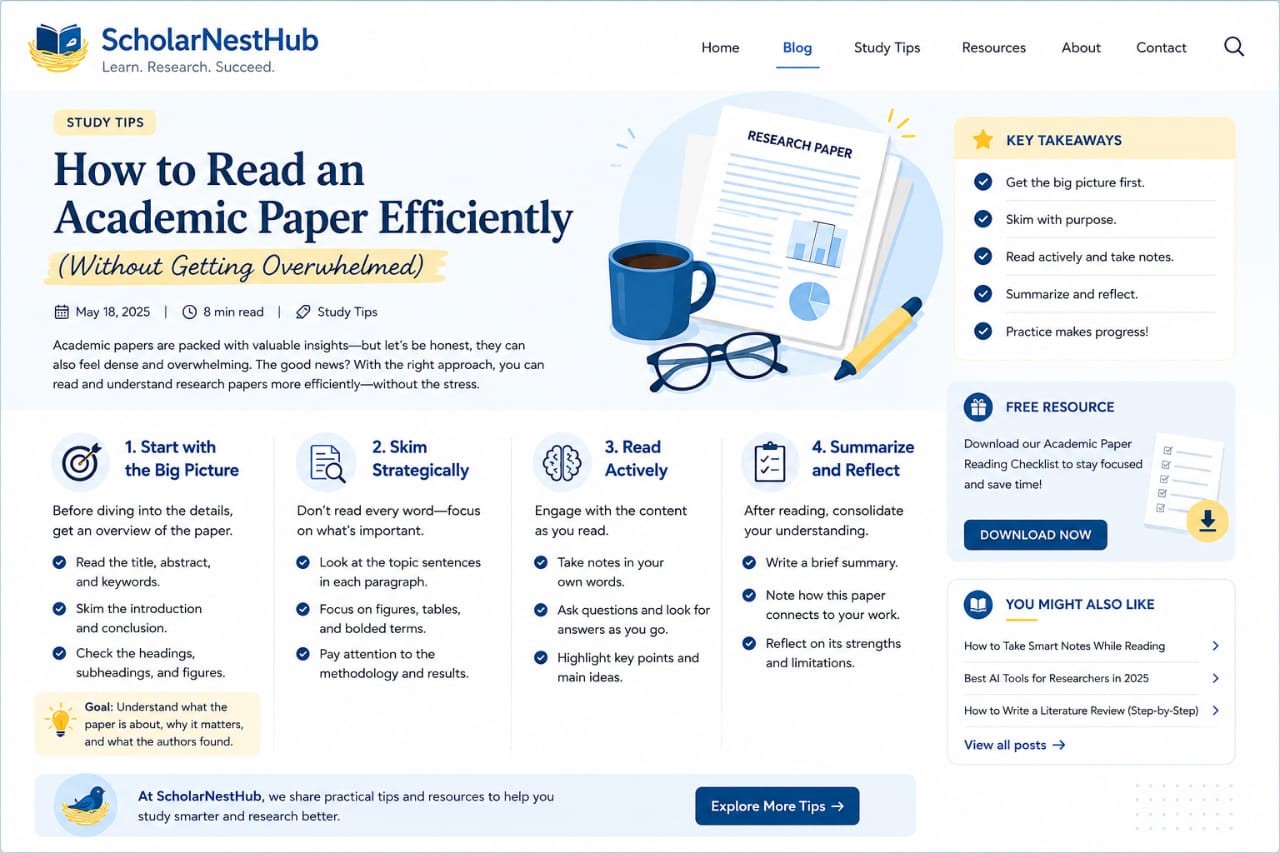
Instead of reading top to bottom, experienced researchers read out of order — front-loading the sections that tell them the most in the least time, then deciding how deep to go from there.
Step 1: Read the Abstract First — and Slowly
The abstract is a compressed version of the entire paper: the problem, the method, the key finding, and often the implication. Read it twice if you need to. If the abstract doesn't match what you're researching, you can often stop there and move to the next source, saving significant time.
Step 2: Jump to the Introduction and Conclusion
Before touching the middle of the paper, read the introduction's final paragraph (where the research question and contribution are usually stated) and the conclusion. This mirrors advice from Brown University Library's guide to reading scholarly articles, which notes that scanning the abstract, introduction, section headings, figures, and conclusion first helps you build a mental map of the paper before committing to a full read.
Step 3: Study the Figures and Tables Before the Full Text
Charts, tables, and diagrams are often the fastest way to absorb a paper's actual findings. A results table can tell you in seconds what might take three paragraphs to explain in prose. Look at the figure captions specifically — they're usually written to stand alone.
Step 4: Do a Focused, Purposeful Read-Through
Only now should you read the body sections in full — and even then, not every sentence deserves equal attention. Monash University's guide for student academic success recommends combining detailed reading of the sections most relevant to your purpose with skimming — reading just the topic and concluding sentence of each paragraph — for the rest.
Reading Strategies for Different Types of Papers
Not every academic source needs the same treatment. Adjust your approach based on what kind of paper you're looking at.
Empirical and Quantitative Studies
• Focus on the methodology section only if you need to evaluate how the data was collected or plan to replicate the approach.
• Prioritise the results and discussion sections — this is where the actual findings and their meaning live.
• Note the sample size and context; a small or narrow sample changes how far the findings can be generalised.
Literature Reviews and Theoretical Papers
• Skim for the author's overall argument or framework rather than every citation mentioned.
• Track which studies keep reappearing across your sources — repeated citations usually flag foundational work in that field.
• If you're assembling background reading for your own project, ScholarNest's Project Topics repository can help you see how other researchers have framed similar literature reviews across disciplines.
Note-Taking Systems That Save You Time Later
Reading efficiently is only half the job — if your notes are disorganised, you'll end up rereading the same paper weeks later. Build a simple system from the start.
The One-Page Summary Method
For every paper you read in depth, capture five things on a single page or note card: the research question, the method, the key finding, one limitation, and how it connects to your own topic. This forces you to process the paper actively instead of just highlighting sentences.
Building a Reading Log for Literature Reviews
If you're working on a project or thesis, keep a simple spreadsheet or table with columns for author, year, method, key finding, and relevance. This turns dozens of scattered PDF notes into one searchable reference you can scan in minutes instead of re-opening every file.
Common Mistakes That Slow Students Down
• Reading every paper cover to cover regardless of relevance — not every source deserves the same depth of attention.
• Highlighting too much text, which defeats the purpose of highlighting in the first place.
• Getting stuck on unfamiliar terminology in the first paragraph instead of continuing and returning to it later.
• Not recording where information came from, which leads to frantic re-searching during the referencing stage.
• Treating the methodology section as mandatory reading even when your interest is only in the findings.
When to Go Deep vs. When to Move On
A useful rule: if a paper's abstract, introduction, and conclusion strongly match your topic, invest the time in a full detailed read. If it's only tangentially related, skim for one or two useful points and move on. Trying to read every source at maximum depth is one of the biggest reasons literature reviews take far longer than they need to.
Key Takeaways
• Don't read academic papers start to finish — read the abstract, introduction conclusion, and figures first to decide if the full paper is worth your time.
• Combine detailed reading of relevant sections with skimming of the rest, rather than reading everything at the same pace.
• Adjust your approach depending on whether you're reading an empirical study, a literature review, or a theoretical paper.
• Use a consistent note-taking system — like a one-page summary or reading log — so you never have to reread a full paper just to recall its main point.
• Not every source deserves a full, in-depth read; match your reading depth to how relevant the paper actually is to your work.
Frequently Asked Questions
1. How long should it take to read an academic paper?
A focused first pass — abstract, introduction, conclusion, and figures — can often be done in 10–15 minutes. A full detailed read of a highly relevant paper may take 45–90 minutes depending on length and subject complexity.
2. Is it okay to skip the methodology section?
Yes, if your goal is simply understanding the findings rather than evaluating or replicating the study. If you're citing the paper as strong evidence, however, it's worth checking the methodology to judge how reliable the results are.
3. What's the difference between skimming and detailed reading?
Skimming means reading only the topic and concluding sentences of each paragraph to get the general gist. Detailed reading means working through every sentence of a section carefully, usually reserved for the parts most relevant to your purpose.
4. How many papers should I read for a literature review?
This depends on your course requirements, but breadth matters more than exhaustively reading every available paper. It helps to first understand the difference between primary and secondary sources so you know which papers deserve a closer read and which can be cited more briefly.
5. Should I print papers or read them on screen?
Either works — what matters is that you can annotate. Digital PDF readers with highlight and sticky-note features work just as well as printing, as long as you're actively marking up the text rather than passively scrolling.
6. How do I deal with unfamiliar jargon while reading?
Keep a running list of unfamiliar terms as you read instead of stopping to look each one up immediately. Often, meaning becomes clear from context by the end of the section, and you can look up only the terms that remain unclear afterward.
7. What should I do if I don't understand the statistics in a paper?
Focus first on the plain-language interpretation the authors provide in the results and discussion sections. You don't need to fully understand every statistical test to grasp what the finding means and how strong the evidence is.
8. How do I know if a paper is actually relevant to my topic?
Check the abstract against your research question before reading further. If the abstract doesn't address your specific angle, skim the introduction and conclusion for a secondary check before deciding to invest more time.
9. Can this approach work for reading textbooks too?
The same principles apply loosely — reading chapter summaries, headings, and topic sentences first — though textbooks are usually written for a general student audience and are less dense than peer-reviewed journal articles.
10. What if I need help writing up my findings after reading?
If you've done your reading and need support turning it into a polished project or assignment, ScholarNest's academic writing service connects students with experienced writers for structuring, editing, and refining research work.
Conclusion
Reading academic papers efficiently isn't about reading faster — it's about reading in the right order and matching your depth of attention to how relevant each source actually is. Start with the abstract, map the paper's structure before diving in, and keep your notes organised as you go. With a system like this, a stack of journal articles becomes manageable instead of overwhelming.
If you're currently working on a research project and need reliable topics, guides, or writing support to go with your reading, explore ScholarNest's full range of academic resources to keep your momentum going.
Need help on your own project?
Browse ready-made materials or request a custom topic from a verified academic writer.